
You are doing everything right. Putting a post on LinkedIn three times a week. You set the hooks as interesting as possible with the hashtag and publish the post at 8 PM because you read blogs somewhere saying that was the peak time.
And your posts are getting likes from your team members and friends, and that’s it.
A LinkedIn AI Agent exists exactly for this moment, because the problem was not in your writing, niche, or consistency. The real problem is that you are posting blindly into the LinkedIn platform, which decides the reach of your post in the first few hours of posting the content. And you are not getting what was actually working right now.
The Hidden truth of the LinkedIn Algorithm nobody talks about
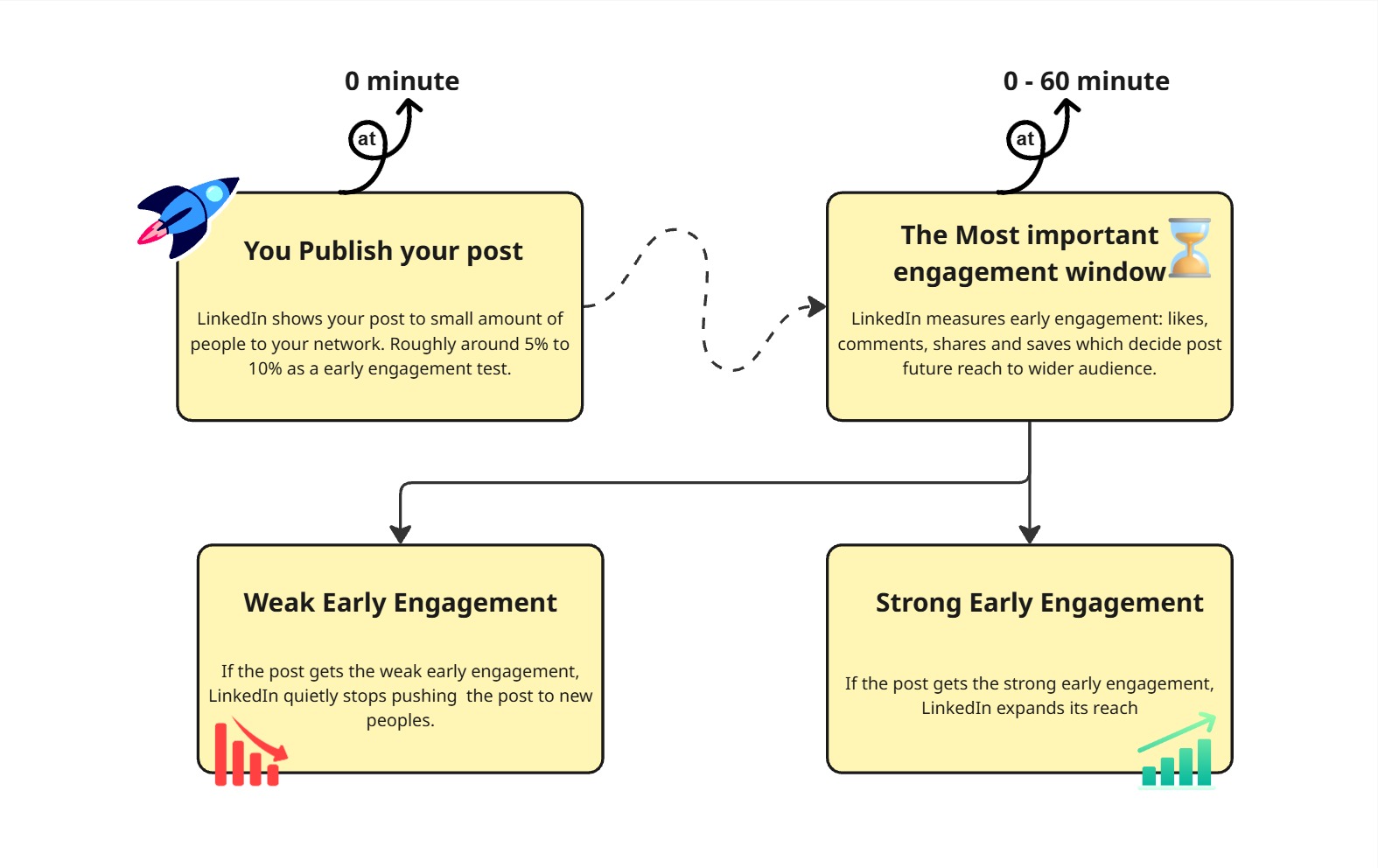
LinkedIn actually doesn’t care about the content at first. It rewards timely content first.
The algorithm is designed to evaluate a post based on the reach of the first few hours, especially the first hour after you publish the post. If the post gets significant early engagement, such as likes, comments, shares, and saves, LinkedIn expands its reach. If it doesn’t get the early engagement most of the time, the reach of the post diminishes, and later it moves on as if nothing happened.
Which means that a decent post about a trending topic can outperform an excellently written post about something that the algorithm isn’t boosting currently.
We know it’s not fair, but that’s how it works.
So while you’ve been refining your writing, the game has been played at one level above that of real-time momentum. And a lot of people don’t know that it even exists.
Your LinkedIn isn’t broken, your approach is
Now we understand with a real-world example,
Assume that you are a chef, and you’ve trained for years. You know all about your recipes. You turn up to the restaurant each day and cook your signature dishes with love and care.
But nobody told you what the customers are actually craving for or what’s trending in the market. In the meantime, other chefs in the town check the demand daily and update the items in the menu accordingly.
Guess whose restaurant is full of rush?
That’s the major difference between posting blindly and posting with the LinkedIn AI Agent. real-time intelligence.
The professionals who are reaching many people on LinkedIn aren’t necessarily good writers. They just know what will sell in the market very well. Those who know which hooks will get more comments, which format the algorithm is favoring, and which keywords are gaining momentum are highly successful.
What “Trending” really means on LinkedIn is not what you think
Don’t assume that LinkedIn has a dedicated trending section like Twitter(X). It doesn’t work that way.
Trending on LinkedIn is more nuanced. It appears to be in some pattern which is a group of highly performing posts and all are using a pattern to it(Individual story → Insights → Call To Action), a popular keyword appearing in multiple places in your area, a hook that suddenly spikes up and getting 3x the average comment rate, a hashtag that’s boosting more reach than the previous month.
Most importantly, none of these is visible in your feed. You have to manually check the posts one by one through hundreds of posts, then track the engagement metrics, understand the pattern, and then summarise all that into a post content every single day is very hard.
Nobody does that, and more importantly, nobody needs to do it.
This is the exact place where our LinkedIn AI Agent steps in and solves the issue.
What is the purpose of the LinkedIn AI Agent, and what steps are involved?
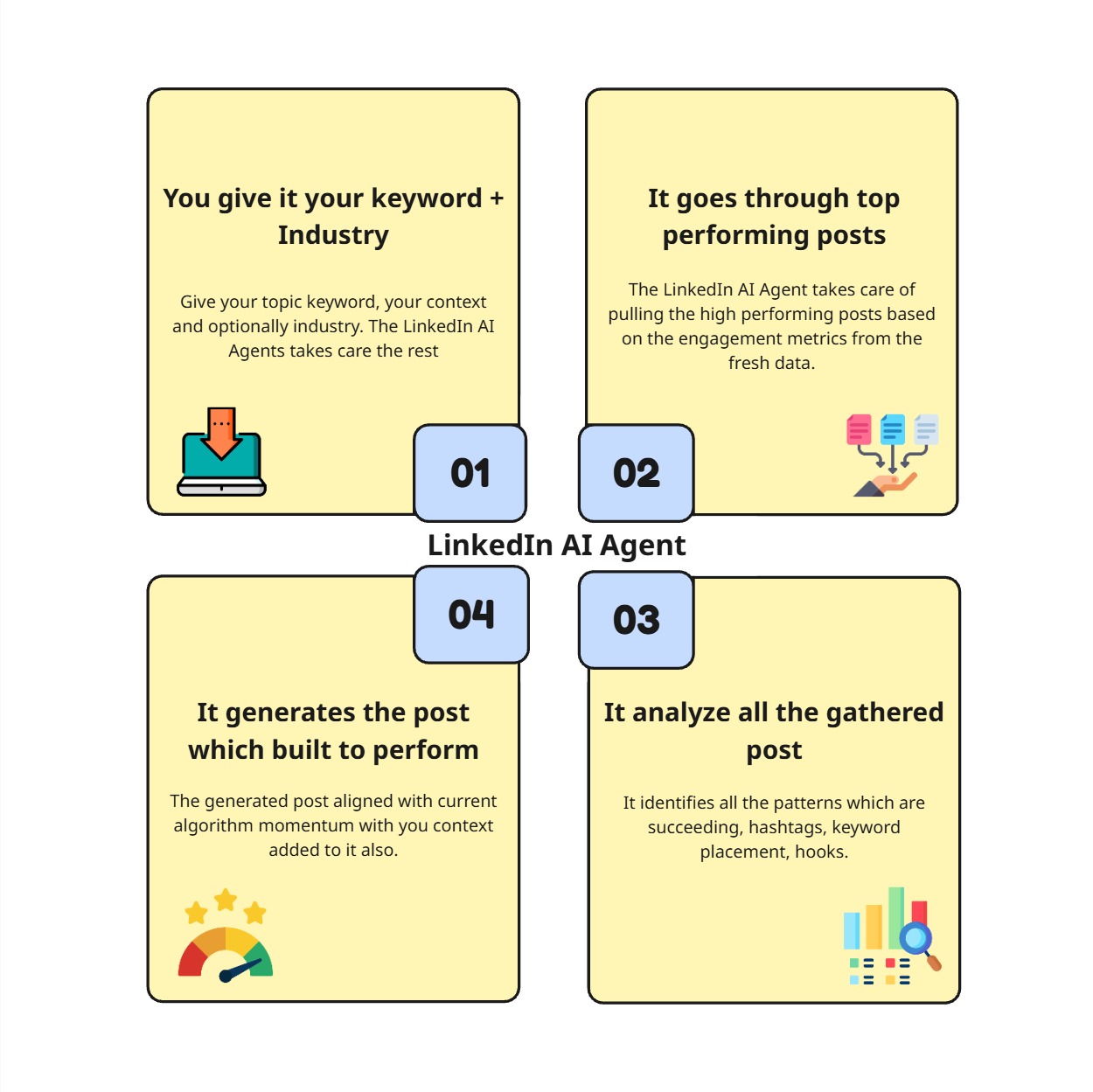
Yes, I know there are a lot of AI tools to generate a post, but the difference is that it analyzes your industry with the keyword and finds the high-performing posts, identifying their patterns, hooks, keyword usage and placement, format, hashtags, and generates a post based on the gathered data. So the generated post is likely to reach a wider audience.
Step 1: You give it your keyword + Industry(optional)
The first step begins here. Enter your keyword along with your context and, optionally industry as well.
Api end point for trending posts
Important: LinkedIn does not offer a public API for searching other people’s posts. The example below uses a third-party service on RapidAPI, which is unofficial and not endorsed by LinkedIn. Collecting LinkedIn data this way may breach LinkedIn’s User Agreement, so review the terms and use such services at your own risk.
https://fresh-linkedin-profile-data.p.rapidapi.com/trending-postsExample curl command
curl --location 'https://fresh-linkedin-profile-data.p.rapidapi.com/trending-posts' \
--header 'Content-Type: application/json' \
--header 'x-rapidapi-host: fresh-linkedin-profile-data.p.rapidapi.com' \
--header 'x-rapidapi-key: YOUR_RAPIDAPI_KEY' \
--data '{
  "search_keywords": "AI",
  "sort_by": "Latest",
  "date_posted": "",
  "content_type": "",
  "from_member": [],
  "from_company": [],
  "mentioning_member": [],
  "mentioning_company": [],
  "author_company": [],
  "author_industry": ["Software Development"],
  "author_keyword": "",
  "page": 1
}'
Step 2: It fetches all the high-performing posts
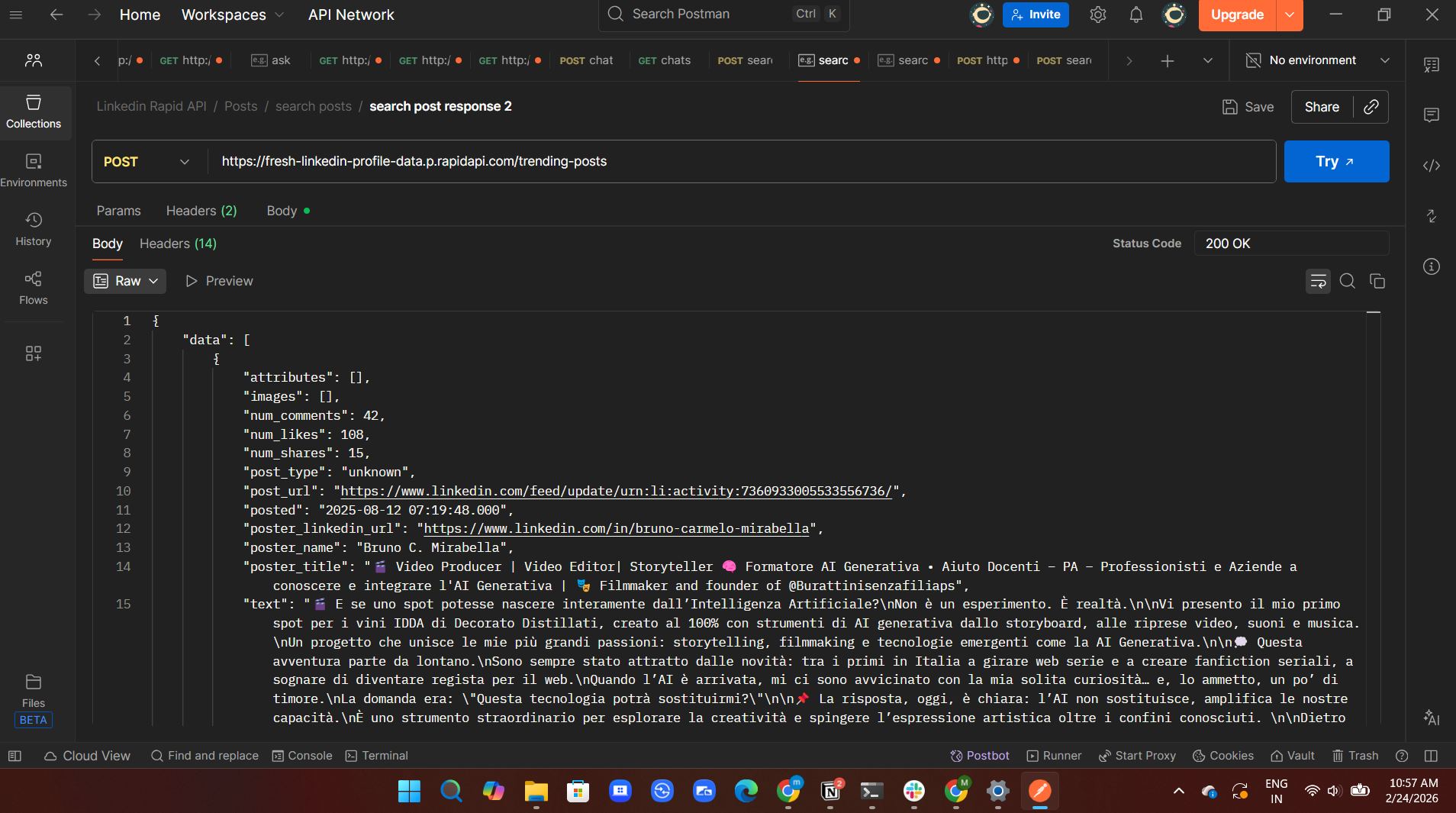
Once it has your keyword and the information you gave, it fetches the latest posts on that topic and ranks them by engagement to find the top performers.
Example responses:
Step 3: It analyzes all the gathered posts
This is the place where it gets exciting. The LinkedIn AI Agent not just filters posts and hands them to you. It reads all the top-performing posts and understands the hook patterns, which hashtags are used to gain momentum, keyword placements, and the format used to gain attention.
Step 4: It generates the post
Now the LinkedIn AI Agents generate the post, but not from scratch; it takes everything it learned from the gathered posts, the trending hooks, the attention-gaining formats, momentum-gaining hashtags, and keyword placements for better reach, then it implements all the best features in the final post.
A post built around exact patterns, the algorithm is currently favoring, in your voice, for your audience.
A LinkedIn AI Agent helps you to post at the intersection of what you want to say and what the algorithm currently favors. It balances both.
But won’t this make my content sound generic?
It’s actually a fair concern, and honestly, it feels only true if you use the agent like a vending machine.
The correct way to use the LinkedIn AI Agent is not just to generate a post, copy and paste the content, then publish it. LinkedIn AI Agent actually works better when you feed your data to understand you better and generate the post with your perspective as much as possible.
After generating the post, you still have an option in the LinkedIn AI Agent to add your thoughts, the real-world example you have experienced, and then the agent will refine the post even better. The LinkedIn AI Agents hold the structural knowledge, like what people like to hear, which format is currently working, and the hooks that are attracting more people to comment right now. With the blend of knowledge and experience, your post is great.
Conclusion
Yes, you finally stop scrolling and read this part carefully.
Your LinkedIn Post visibility problem is not with your discipline, not consistency, and not even the strategy in the traditional sense. You must focus more on the content game without knowing the real-time intelligence layer, which actually affects the outcome of the post to reach more people. The algorithm doesn’t care how hard you worked on your content. It cares about the engagement within the first few hours of posting.
Post the content with the momentum. Not just random quality content, because without a consuming audience, quality content is not going to succeed.
The professionals, those who are using the LinkedIn AI Agent, aren’t cheating. They are just playing with better knowledge than the rest of the people, and in the current market, the amount of data or information is the difference, which plays a major role in the difference between reaching 300 people and 30000 people.
Content without momentum is invisible. Agentzee (Agentzee) helps you build that momentum from the moment you post.