
A mid-sized veterinary clinic gets about twelve appointment slots a day. While the waiting list stretches two weeks out. Somehow, on any given day, three of the slots are … just empty, not called in advance, not rescheduled, the customers just ghosted.
The dog owner who booked an appointment for dental problem forgot the appointment. The cat owner who booked an appointment for follow-up vaccination got into a back-to-back meeting and never reached back. The owner of the golden retriever with post surgery check up says he never got a reminder. He probably received the reminder message but might have ignored it.
The receptionist spends forty minutes in the morning trying to fill up the three empty slots by from the waiting list. Two people didn’t pick up, one said yes but didn’t show up in the clinic. Net result three empty slots $600 lost in revenue. If it’s occasional, we can ignore it but if the problem occurs on a regular basis, then we must fix this recurring problem.
It’s not really the pet’s owner’s fault. People are genuinely busy, A veterinary doctor’s appointment for their cat doesn’t sit at the top of the priority list unless something is nudging them in their own timeline.
The real cost of the forgotten vet appointment.
Before we come up with a solution, can we have a moment and rethink the problem for a second?
The ghosted person is not just a lost appointment, it’s a chain reaction.
The slot might have gone to someone on the waiting list. Instead, it was an empty time gap in a busy day. Since the schedule is empty, the overhead won’t disappear magically like the staff salaries, equipment running costs, and rent, none of which pause due to Bruno’s forgotten appointment.
A clinic which operates 12 appointments a day, with an average of $200 per visit. On average 20-25% of the slot becomes empty (which is completely normal for the healthcare industry, especially for vet doctors, it’s high) so it roughly translates to a $18,000 loss in revenue per month.
And the patients in the waitlist make it more painful. Because there are people who actually want the slots who would have shown up, but they were waiting in the list for a week or another. Since the communication is not happening in an efficient way. A single receptionist already has more tasks to handle, answering the incoming queries, appointment booking and reschedules, day-to-day activities. So, on top of that, making a reminder call is not easy.
This is where an outbound AI voice agent changes the entire game.
So, how does an outbound AI voice agent solve this issue?
An outbound AI voice agent is an AI system that actually makes phone calls on your behalf. No text messages, no emails, which land in the promotional section next to the other advertising emails. Real phone calls to communicate with your customer with a natural human tone, and no one will figure out that it’s an AI speaking to them.
Let’s think in this way, hiring a staff member who never sleeps, never forgets a thing, doesn’t get angry when someone speaks in a rude way, and speaks cheerfully to everyone every day.
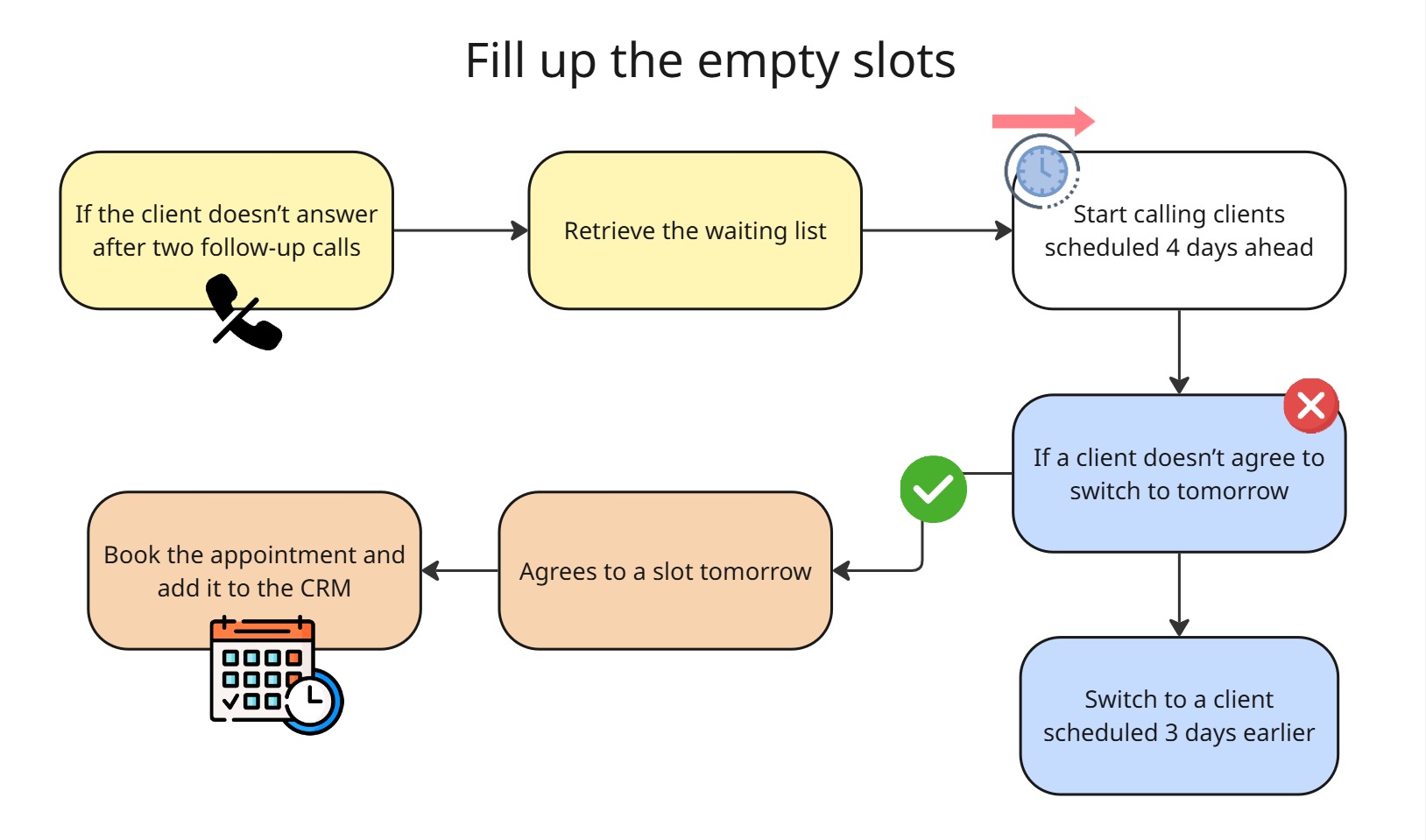
For a veterinary clinic, the outbound AI voice agent is a profitable investment because the minute a slot goes cold, it automatically starts to call the clients on the waiting list and convinces them to utilise the cold slot. Every single step occurs automatically without human intervention. That’s the magic of AI agentic system.
Let’s see how to integrate an outbound AI voice agent into our existing business model.
Step 1: Connect the AI agent to your existing appointment system.
The outbound AI voice agent connects to your existing system via the MCP protocol. It might be any system or workflow, VetPort, Digitail, Easy Vet, Google calendar or a very organised spreadsheet your receptionist maintains since 2018 and refuses to give up 🤷. The AI agent pulls all the relevant information for an appointment: the owner’s details, the pet’s name, and what the visit is actually for.
The only constraint is that your existing appointment management system must have some sort of API to fetch all the appointment details. If not, then it’s difficult and requires more steps to automate the workflow for the outbound AI voice agent.
Step 2: Figure out the right reminder window.
Timing is everything. If you call too early, people might confirm the appointment, but eventually they might forget it again. Calling two hours before is useless, and there’s nothing to do if the owner forgets the appointment because they might be in the middle of something which they can’t sacrifice just for the pet’s regular check-up.
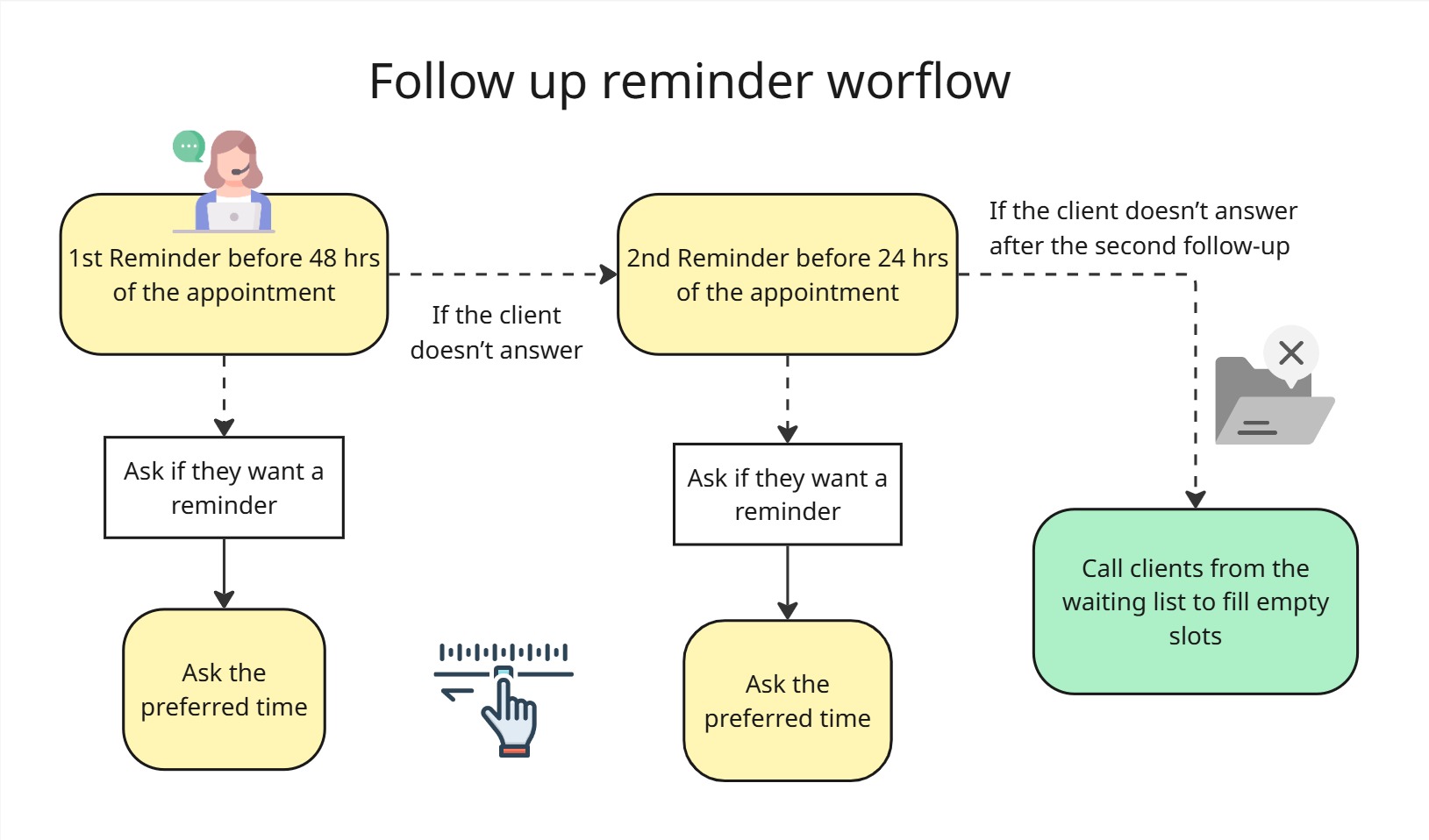
The sweet spot is 48 hours before the appointment. Set the 1st reminder 48 hours before the appointment. If the client didn’t pick up the 1st call. Then schedule a 2nd call 24 hours before the appointment.
Also, you should respect the time of the client, schedule a rule which stops the AI agent from making any calls before 9 AM and after 7 PM. Because calling someone at 6:45 AM to remind them about their cat’s deworming appointment is a great 🎉 way to lose a client.
Step 3: Handling the conversation during the reminder call (knowledge base).
This is the part that most people raise their eyebrows at, what if the client asks an unexpected question to the AI agent?
The outbound AI voice agent is integrated with a centralized Knowledge base, so if any clients ask any of the below question for example:
“Suddenly, my parrot is losing feathers. I am worried, can I come to the clinic right now?”
“Can I reschedule my appointment from today to tomorrow?”
“How much does a general health check-up cost for a dog?”
“If there is any emergency with my cat, can I walk into the clinic ?”
For every single question, the AI agent gets the correct answer from the knowledge base and replies to the client with precision. Also, if anyone asks to reschedule the appointment or cancel it, the AI agent can do it on the spot without any user intervention.
The knowledge base:
You must prepare and feed the system with all the information that the receptionist knows about the working hours, doctors’ information, receptionist information, parking instructions, cancellation policies, refunds etc. This data improves the quality of the AI agent makes the system more autonomous and requiring less human intervention.
Step 4: The nudge theory.
The special recipe to make the outbound AI voice agent successfull is by utilising the nudge theory. We already know this from our childhood, our nudges us to do a good thing, which we ignore all the time. After we becoming as adult, there is no to nudge us to do a work which gives a positive outcome. But now there is no one to remind us we meant to forget things.
So when the outbound AI voice agent makes the 1st call before 48 hours it also asks the client, “Can I remind you before 12 hours of the checkup?” if the client says yes. The AI reminds the person. And your slots will not be empty.
Step 5: Log everything, generate a report and analyse it periodically.
Final thing to do is we need to log every single thing the calls, the conversations with clients, the reschedule ratio, and the cancellation reason. Finally using these data we can figure out which part of the week has the most empty slots. Also use these as feedback to optimise your workflow and constantly update your knowledge base.
Other things the outbound agent can do
The outbound AI voice agent isn’t just a reminder machine; it can do a couple of things inside the client call, which improves the revenue.
Upselling: If Simba is coming for a vaccination and the records show the dental check-up is overdue, the ai agent can mention it on the call. “Would you like to add the dental check on the same visit so that you don’t need to come for another visit?”. Most owner says yes. It’s convenient for them too and it’s an extra booking for the client. It’s a win-win 🏆 situation for everyone.
Post visit follow-up: Three days after the vaccination, the outbound AI voice agent can call the client and ask, “How is Simba doing after the vaccination? Is there anything you need to share with us?”. It built a trust with the clinic no other way of communication can do it. Also, it often catches the minor issues before it developing into an emergency.
Conclusion:
Empty slots are the problem of the past. After implementing the outbound AI agent, the clinic doesn’t need to worry about clients ghosting them. Because before a slot goes empty, it will be seen before 24 hours, and the outbound AI agent starts to make calls from the waiting list to fill up the gaps with any human intervention, it’s pure productivity.
During the reminder calls, if the client has any complex questions, the AI will try to reply with the most precise answer but if the question is out of context, not available in the knowledge base or the client insist to speak with the doctor or receptionist, based on the availabilit,y it automatically redirects the call.
The implementation of the outbound agent requires so much technical stuffs, the backend needs to be developed, the DB schema should be defined in a scalable manner, the system design should be architected properly and it’s just the beginning lot more stuff needs to be taken care of to make the AI agent work. So the best thing to do is to leave it to the industry specialist.
We at Agentzee have build production grade outbound AI voice agent that handles appointments booking cycle from the first reminder to post visit follow ups. Don’t see purchasing an AI agent as a running cost it multiples your revenue and reduces headaches for you and your employees.
So if you are interested in trying out an outbound AI voice agent please check out this page.