
A customer from Pune raised a price enquiry at 11:45 pm.
No reply.
She waits until morning. By 9 AM, she had already placed the order with one of your competitors. Who had WhatsApp AI chatbot which replied to her while you were asleep.
It’s not a hypothetical scenario. That Tuesday night for thousands of indian businesses, and it’s costing them more than they realise.
India’s WhatsApp user base has over 500 million active users. It’s the default communication channel for friends, families and increasingly for small-scale commerce brands. Where customers use WhatsApp to ask about product updates, confirm orders, track deliveries, raise complaints and make payments. The communication channel is already mature in this market space.
What’s missing here is the infrastructure to respond at the speed customers now expect.
Let’s check out the number here.
If your business gets 100 WhatsApp enquiry a day. 30% of the messages came after 7 PM, but there is no one out there to respond to them after working hours. If just 10% of them are your potential customer if we can message them with a timely reply.
If you add those numbers over a year, it will be hard to ignore them.
The problem isn’t that Indian businesses don’t care about WhatsApp. Most of them do really care. The problem is that they are treating it like every conversation should be handled by the business owner themself which is can’t be done.
A well deployed WhatsApp chatbot among Indian businesses can resolve around 70% of the repetitive questions on its own, leaving the remaining 30% for your team.
What a WhatsApp chatbot for Indian businesses actually does.
Before we get into the implementation details, let’s be clear about what we are talking about.
When we say a WhatsApp chatbot for Indian business isn’t about an auto-reply that says “Thanks for your messages, we will get back to you soon”. That’s not automation. It is a polite way of doing nothing.
The truly built WhatsApp chatbot running on the WhatsApp Business API with the AI layer can qualify leads, answer product questions, send catalogues, generate and share payment details, book an appointment, cancel an appointment, reschedule appointments and trigger a workflow in your CRM. All without any human intervention.
Think of it like hiring a receptionist with a superpower who can handle 500 conversations simultaneously. Speaks multiple languages like Hindi, Tamil, Telugu and English. Never loses patience, even if the customer asks the same question for the fourth time.
old way: When the conversation is handled by humans manually, it will be like 9 to 6 queued conversations, delayed response to customers and missed leads. New ways: When Indian businesses integrate a WhatsApp chatbot into the system, instant replies, zero queue and zero missed opportunities.
Steps to integrate a WhatsApp chatbot into Indian businesses.
Step 1: Get official API access; there should be no shortcuts.
The standard WhatsApp business is just the starting point, once your business scales to a certain level, you can’t keep up with the customer by following the traditional methods. In order to handle business which scale up, you access the WhatsApp business API through official business solution providers like Twilio, Agentzee or Interakt.
This gives you a verified green tick sender number, the ability to handle high volume messages and the infrastructure for your chatbot to external systems.
Watch out: Third-party tools that automate the standard WhatsApp app violate WhatsApp terms of service. The number will get banned, sometimes permanently.
Step 2: Set up the knowledge base.
The knowledge base is one of the most critical parts. Because it becomes the brain of the WhatsApp chatbot for your Indian businesses. Research and gather the most asked questions, the product catalogue you serve, the updated pricing details, communication details, return policy, and refund policy.
So when every customer messages the WhatsApp AI chatbot, it knows where to pick the information and respond to the customer with the correct answer. This will be the first layer of automation for all the customer queries. The AI chatbot picks the answer from the knowledge base. Now, around 40% of your daily manual messages are automated.
The most important thing is that if you have any specific information that the customer asks for that is not mentioned here, add it to the knowledge base in the form any format, text file, Word, Excel, or just text.
Step 3: Integrating with your existing tools.
When Indian businesses integrate a WhatsApp chatbot, they should not stop with the knowledge integration. You should expand the capabilities by enabling it to interact with your existing business workflow.
For data retrieval and adding new data to your existing workflow, it might be a CRM tool, Notion, Google sheets or an old Excel sheet you’re maintaining for years.
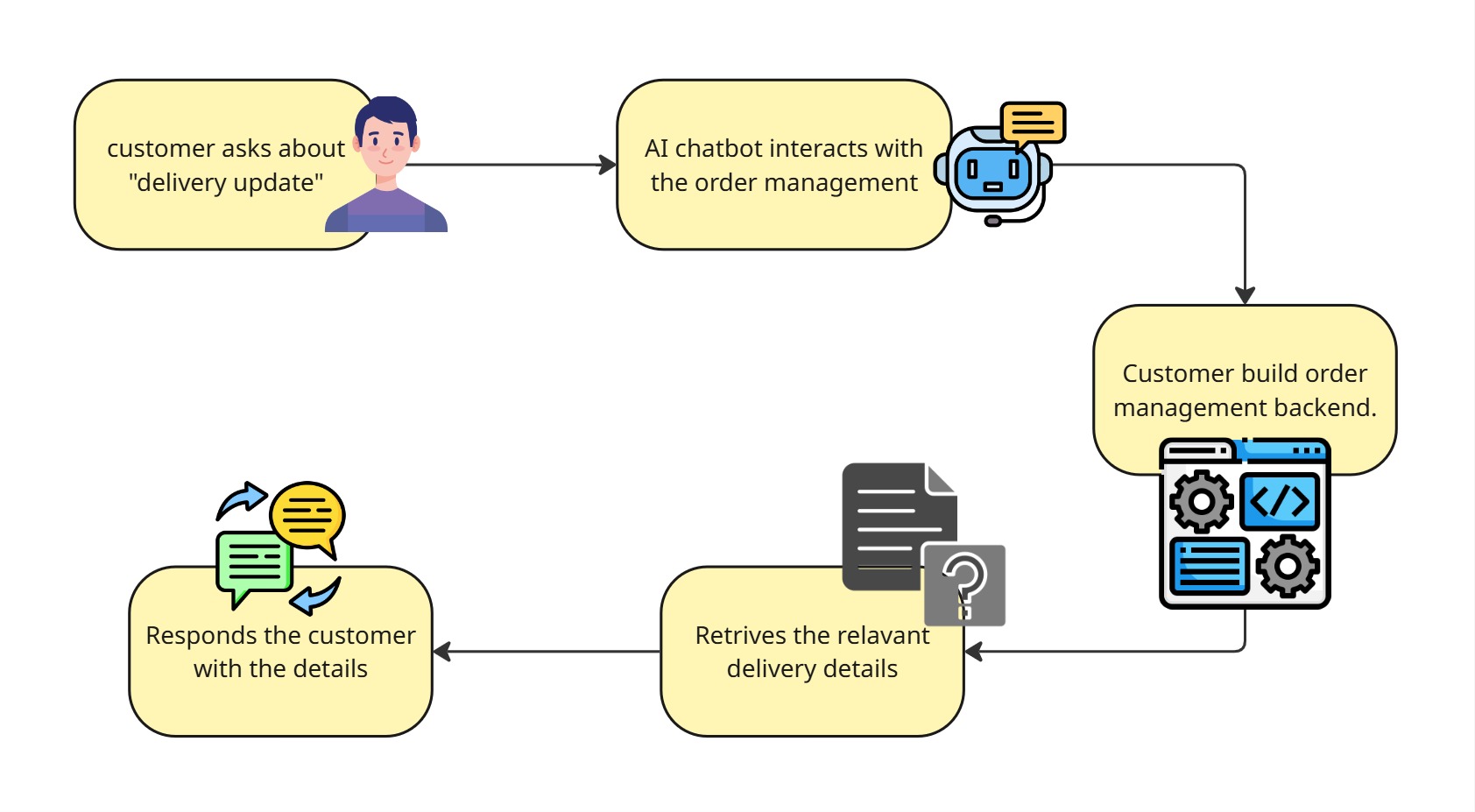
For managing the order, connect it with the existing order management tools like Shopify, WooCommerce or any custom-built website backend. For managing the payments, connect with Razorpay, PayU or the current payment vendor you use.
Once all the systems are integrated, when a customer messages the WhatsApp AI chatbot, it automatically retrieves the order details and replies to the customer instantly. Now this is the second layer of automation, which changes the operations of your business.
Step 4: Set human Escalation rules.
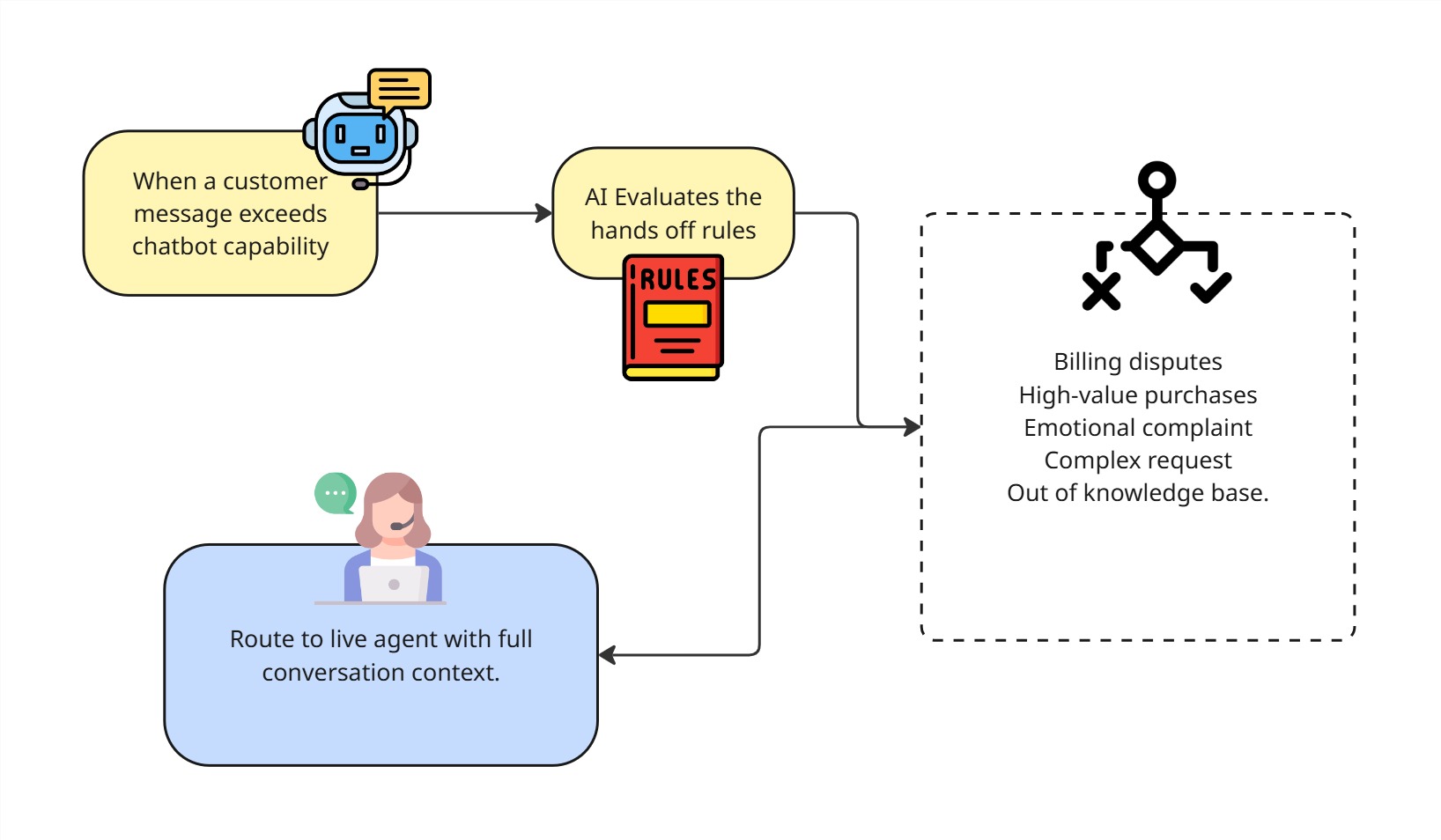
Not every conversation belongs to the chatbot. Define your escalation trigger clearly, it’s commonly called Handoff rules.
Billing disputes, high-value purchases → Redirect to a human.
Complaints with emotional charge, anything requires judgment → redirect to a human.
payment-related issues - redirect to a human.
If the user insists on speaking to a human → redirect to a human.
Also, the important thing is that while redirecting the conversation, we need to preserve the full conversation data. So that when someone takes over it they don’t want to ask the same repeated question again. Also, it makes the customer uncomfortable.
Step 5: Launch small, measure everything, then scale.
When you’re ready, don’t push the automation to all of your customers. Initially, open the WhatsApp AI chatbot to 10% of the traffic you have.
Analyse and monitor the following metrics:
First response time - if it takes more than 5 seconds, please check the infra metrics.
Self-resolution rate - aim 70% of the conversation to be resolved without human intervention.
Lead to the conversation ratio.
customer satisfaction ratio.
After getting the customer feedback and satisfaction ratio, update your pipeline according to it. Also, using the metric mentioned above and the logs generated by the system, please analyse and fix where the optimisation is needed.
Also, every month, generate the monthly report, update the FAQ section, and add updated information in the knowledge base.
The window is open, but not forever.
The chatbot is built, the flows are tested, and the integrations are working. But no one is using it. Because nobody told customers it existed.
Add your WhatsApp number to every invoice, email signature, packing insert, Google Business Profile and social media profiles. A single line is enough “Message us on WhatsApp for instant replies”.
The technology works only if the conversation starts.
Conclusion
Right now cost of businesses is currently really on the traditional method for WhatsApp conversation. This is the competitive information for anyone who moves to the automation workflow first. WhatsApp chatbot in Indian business is a one-time opportunity for all businesses which want to improve their brand value among customer support space.
The businesses that are opted in today are making a technological bet and making revenue decisions. The customer intent is already on WhatsApp; the question is whether your business is ready when the time comes.
If you are thinking to implement the WhatsApp chatbot automation workflow for instant customer replies and supporting the user who messages after business hours. Agentzee helps Indian businesses deploy WhatsApp AI chatbot that works for their custom needs. Without the six month implementation timeline or the enterprise price tag see how it works for you.
To integrate a WhatsApp AI chatbot to your existing business, please check out this page