
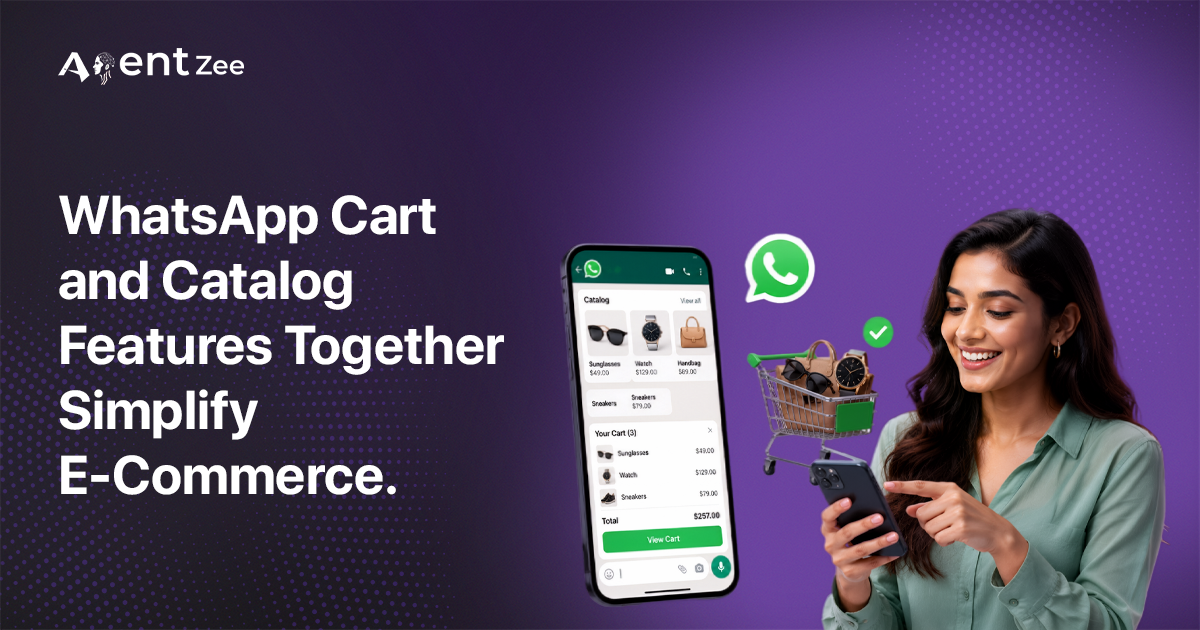
The world of online shopping has changed a lot in the last few years. Customers who previously had no problem filling out forms on websites or waiting hours for a business to respond now expect something altogether different. People always ask for an instant reply, and that experience exists in the apps they use every day.
WhatsApp is a business powerhouse to be partnered with because when it began as a simple messaging app, it wasn’t capable of these processes, but it has evolved into a full-blown commerce platform. Also, WhatsApp enables businesses to display products, answer questions from customers, and take orders, all within the chat window.
But listing products in a WhatsApp catalogue is just a part of the equation. The real difference is when these features are paired with a WhatsApp AI chatbot by businesses. Together they create a fast, personal, and truly effortless shopping experience for the customer.
In this guide, we dissect WhatsApp Catalogue and WhatsApp Cart Management and explain why integrating them with AI automation can change the way you sell. You can also see how the Agentzee WhatsApp catalogue feature works.

What Is the WhatsApp Business Catalogue?
WhatsApp Business Catalogue serves as a digital retail space on WhatsApp. Here in the application, businesses can display their goods or services directly so that customers can buy those particular goods without leaving the app.
Someone can open a business profile that provides a catalogue and immediately access products, view images, read descriptions, and see prices. This all stays in the same conversational environment. This helps the customers to browse far more easily.
For businesses, this also makes the buying process shorter. Customers no longer have to jump between websites or apps to explore products. They can browse and ask questions in the same conversation.
A WhatsApp AI chatbot integrated will bring a next-level experience because it can start a conversation by greeting a customer. Then answer their frequently asked questions in detail, know about the customers, recommend relevant products to them, and also, more than that, it acts as a guide to shoppers through their entire purchase journey.
This helps businesses to respond faster to any customer interaction, and the interaction feels smoother and more convenient for customers.
How Customers Access a WhatsApp Catalogue
Viewing a catalogue on WhatsApp is very simple for customers.
Here is the usual process:
Open the conversation with the business
Tap the business name at the top of the chat
Open the business profile
Select “See All” under the “Products” section
Once selected, the full catalogue appears inside WhatsApp.
Some businesses also place a catalogue shortcut directly in the chat window, making browsing even faster.
This matters because customers prefer convenience. The fewer actions they are able to complete, the greater the probability they are to continue exploring and eventually buy something.
A WhatsApp AI chatbot may assist in this journey by making it smoother. How? It recommends products, showcases bestsellers, or shares direct product links the moment a customer opens a conversation.
Sharing a WhatsApp Catalogue
One useful feature of WhatsApp Catalogues is how easy they are to share with others.
Customers and businesses can:
Share the catalogue directly through WhatsApp
Copy the catalogue link and post it on social media
Add the link to emails or websites
Send products to friends or family instantly
This gets people spreading the word naturally. A happy customer can recommend products to someone else in a matter of seconds. The companies utilizing a WhatsApp AI chatbot can also automate this process by nudging the customers to share the catalogue after a successful purchase or a positive interaction.
The WhatsApp Cart Feature Explained
WhatsApp has a built-in configurable cart system where users can post and update their products. Also, they can collect the products and send an order request.

Just like a regular e-commerce website, the shopping experience is similar but everything happens inside a chat conversation.
Adding Items to the Cart
Here is how customers typically add products:
Open the business chat or profile
Tap the catalogue icon
Browse available products
Tap the “+” button beside an item
Adjust quantities if needed
Customers can also open a product page first and choose “Add to Cart.”
Because the process feels familiar, customers can shop comfortably without needing instructions.
Many shoppers also prefer asking questions before making a purchase. Instead of messaging separately for every product, they can add several items to the cart first and send one enquiry.
WhatsApp AI chatbot becomes extremely helpful by responding to questions about pricing, stock availability, delivery timelines, sizes, customisation options, and many more, without making the customer wait.
Editing the Cart Before Checkout
Before submitting an order, customers can
Add additional products
Increase or reduce quantities
Remove items completely
This flexibility helps customers feel more confident because they remain in control of their purchase.
A WhatsApp AI chatbot can improve this stage further by sending reminders such as the following:
“You still have products waiting in your cart.”
It can also recommend related products based on what the customer has already selected.
These suggestions often feel more natural inside a conversation compared to traditional e-commerce pop-ups.
Placing an Order on WhatsApp
Once customers are ready, submitting an order is straightforward.
They simply tap “Place Order,” and the cart details are automatically shared with the business in the chat. An order submitted in their cart can also be reviewed later by reopening the conversation. This order will only be confirmed once the seller re-confirms it with the customer.
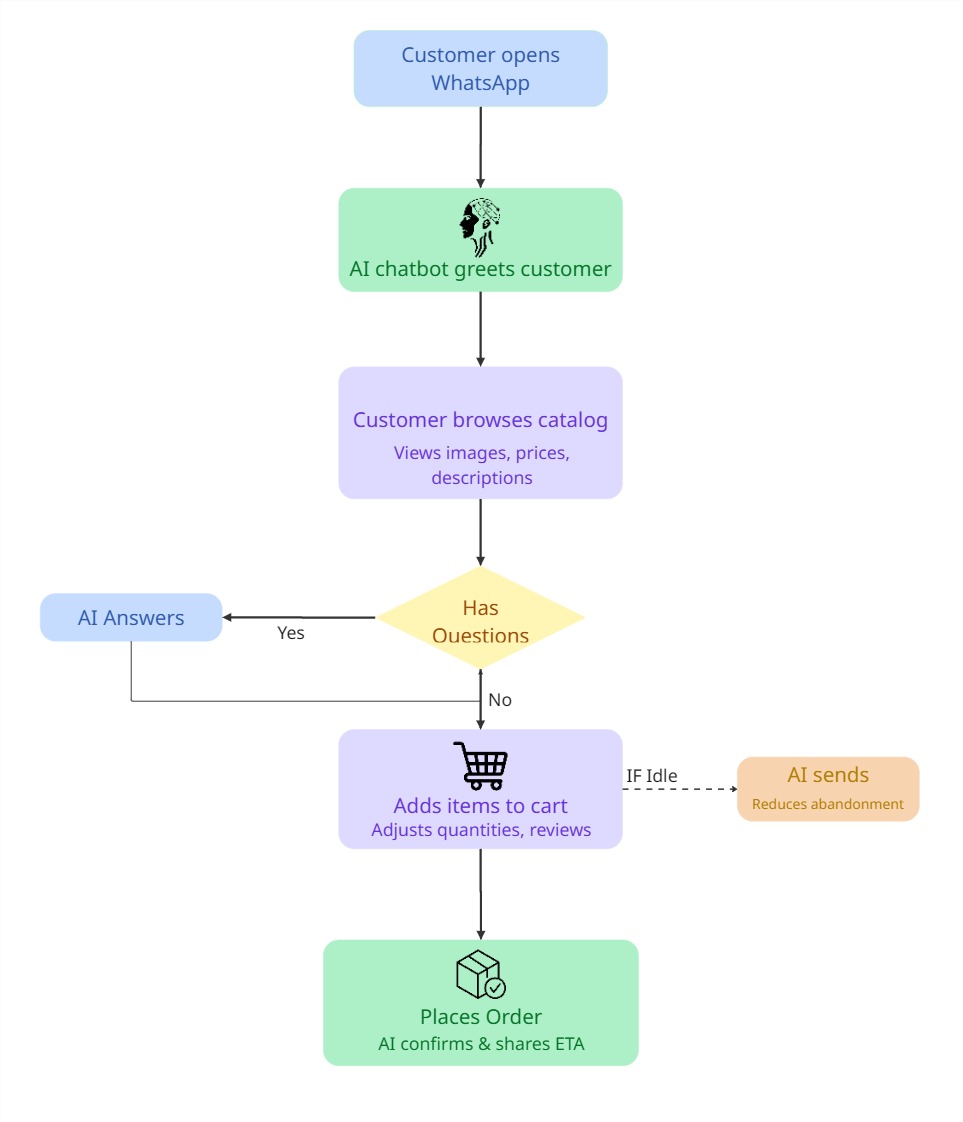
A WhatsApp AI chatbot adds value without making customers wait for manual responses. The chatbot can instantly:
Confirm the order request
Share estimated delivery timelines
Inform customers about stock availability
Collect additional details if required
Transfer the conversation to a human agent when needed
The result is a much faster and more convenient customer experience.
Why Businesses Should Combine WhatsApp Catalogues with AI Chatbots
WhatsApp Catalogues and Cart features already simplify online shopping. But adding AI automation makes the entire experience much more effective.
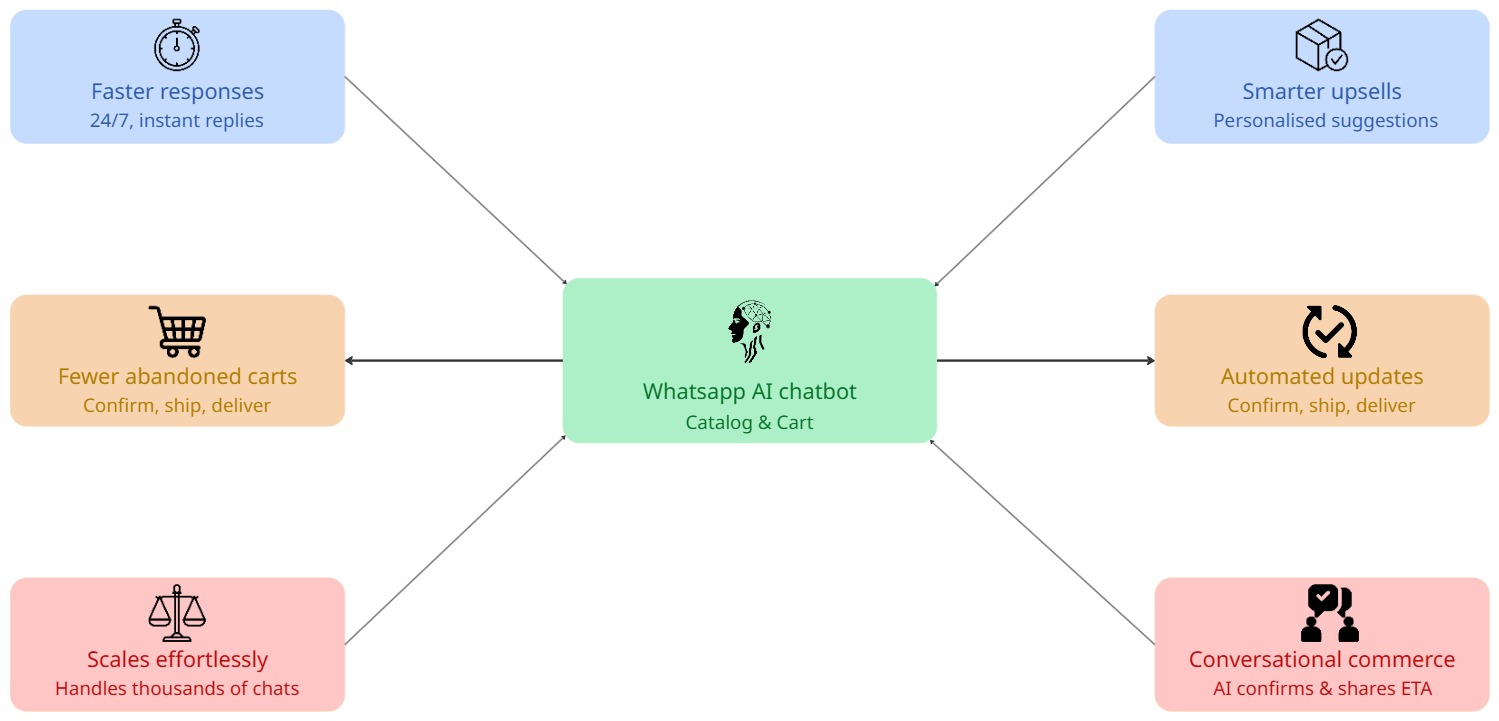
Here are some of the biggest advantages.
1. Faster Customer Responses
Customers expect immediate replies. While a response is delayed, it could indicate a missed sales opportunity.
WhatsApp AI Chatbot is accessible 24/7 to help customers by answering frequently asked questions, suggesting products, and directing them through the buying process at any time of day.
2. Authentic Product Recommendations
AI chatbots can recommend products according to the consumer’s needs.
For example, when someone is looking for shoes, they will be given suggestions for shoes and their related accessories that go well with them during the conversation.
This results in a better shopping experience as well as boosts the order value.
3. Minimal Shopping Cart Abandonment
A lot of individuals who make purchases online leave without purchasing anything.
You can employ the WhatsApp AI chatbot to stay in touch with customers who chose to add items to their cart but failed to place the order. A quick reminder will help them come back so they can wrap up the purchase.
4. Automated Order Updates
Chatbots can handle routine updates automatically, including the following:
Order confirmations
Shipping notifications
Delivery updates
Post-purchase support
Customers stay informed without businesses needing large support teams to manage every conversation manually.
5. Simpler Business Growth
Whether a company gets 50 text messages per day or even thousands of them, a WhatsApp AI chatbot can handle normal conversations consistently.
Even in busy times, customers still get fast replies and reliable help.
Shopping Is Becoming More Conversational
WhatsApp commerce growth reflects evolving customer behaviour. People are tired of a complicated buying process with forms, redirects, and multiple apps. They prefer simple conversations to discover products, ask questions, and complete purchases quickly.
And that’s why conversational commerce continues to grow.
WhatsApp AI chatbots act as a digital sales assistant and are always available. Instead of enabling consumers to browse independently, it helps them through their shopping journey in a way that appears natural and helpful.
This provides smaller companies with an opportunity to compete with bigger brands. For larger companies, it provides a scalable method to manage a huge number of customer interactions effectively.
Final Thoughts
WhatsApp’s catalogue and cart features have already made online selling more convenient. Customers can view products, select what they want, and send orders directly inside a chat. Even so, relying only on a catalogue limits what businesses can really achieve on the platform.
When you add a WhatsApp AI chatbot, the experience completely changes. It solves consumer queries immediately, suggests products, reduces cart abandonment, and manages orders from beginning to end.
A lot of individuals keep shopping in the chat because it feels more and more simple. It also helps businesses with order updates, cart reminders, and handling repeated customer questions without too much manual work.
These days, people don’t really want to wait long for replies from businesses. If you’ve been employing WhatsApp in some capacity, your business will move to the next level. Make shopping effortless and smooth from the very first message, with your catalogue set up and messages automated with a WhatsApp-based AI chatbot such as Agentzee. Companies have less time to react to situations and more time to remain prepared. This creates a more consistent experience for customers and staff alike.
You must already be eager to put this into practice if you have read this far, right?
Let me offer you a simpler solution, which is Agentzee.
(Agentzee WhatsApp AI chatbot)