
Priya manages a telecom support team of eleven. On paper, that number sounds comfortable. In reality, it rarely feels that way. By the time Monday morning begins, they are already catching up. Before the first coffee is even finished, the backlog is waiting for them, hundreds of unread messages carried over from the weekend.
A network tower went down late Saturday. The billing cycle closed on Friday. Somewhere in that flood of messages was a customer who reached out at 1 AM about international roaming not working. No one responded in time. By mid-morning, that customer had already spoken to a competitor. By lunchtime, the number was gone. Priya only learned about it after it had already happened.
It was not due to her team being careless. She knew that her team had been trying their best and that her team could accomplish anything. However, there comes a point when any number of people cannot deal with continuous communication.
In telecom, silence has a cost. Customers do not wait for replies. They simply move on.
Here are the biggest challenges in the telecom industry and how a WhatsApp AI chatbot solves each one.

Why telecom customer support is quietly falling apart
Here’s something most telecom companies won’t admit in a press release: their support systems were never designed for this kind of volume.
Think about what a single mid-sized telecom handles every day. Millions of subscribers. Billing questions that repeat themselves every single month. SIM activations. Network complaints. Plan change requests. International roaming queries from people who are literally boarding a flight in three hours. All of this is landing on a call centre team that is already stretched thin.
The result isn’t hard to guess. Long hold times. Agents who sound like they’d rather be anywhere else. Customers who don’t get answers fast enough quietly start shopping around.
And here’s the part that stings: most of these queries are not difficult. They don’t need a trained human. They need a fast, accurate response. That’s it. Hiring more agents to answer “why is my bill higher this month” for the ten-thousandth time isn’t a strategy. It’s just an expensive delay.
What actually moves the needle is telecom customer support automation through WhatsApp, which is where your customers are already spending hours of their day anyway. A WhatsApp AI chatbot in the telecom industry doesn’t replace your support team. It handles the repetitive stuff so your team can focus on the problems that actually need a human brain.
5 Real situations where a WhatsApp AI chatbot in the telecom industry makes a difference
1. The billing question that comes in every single month
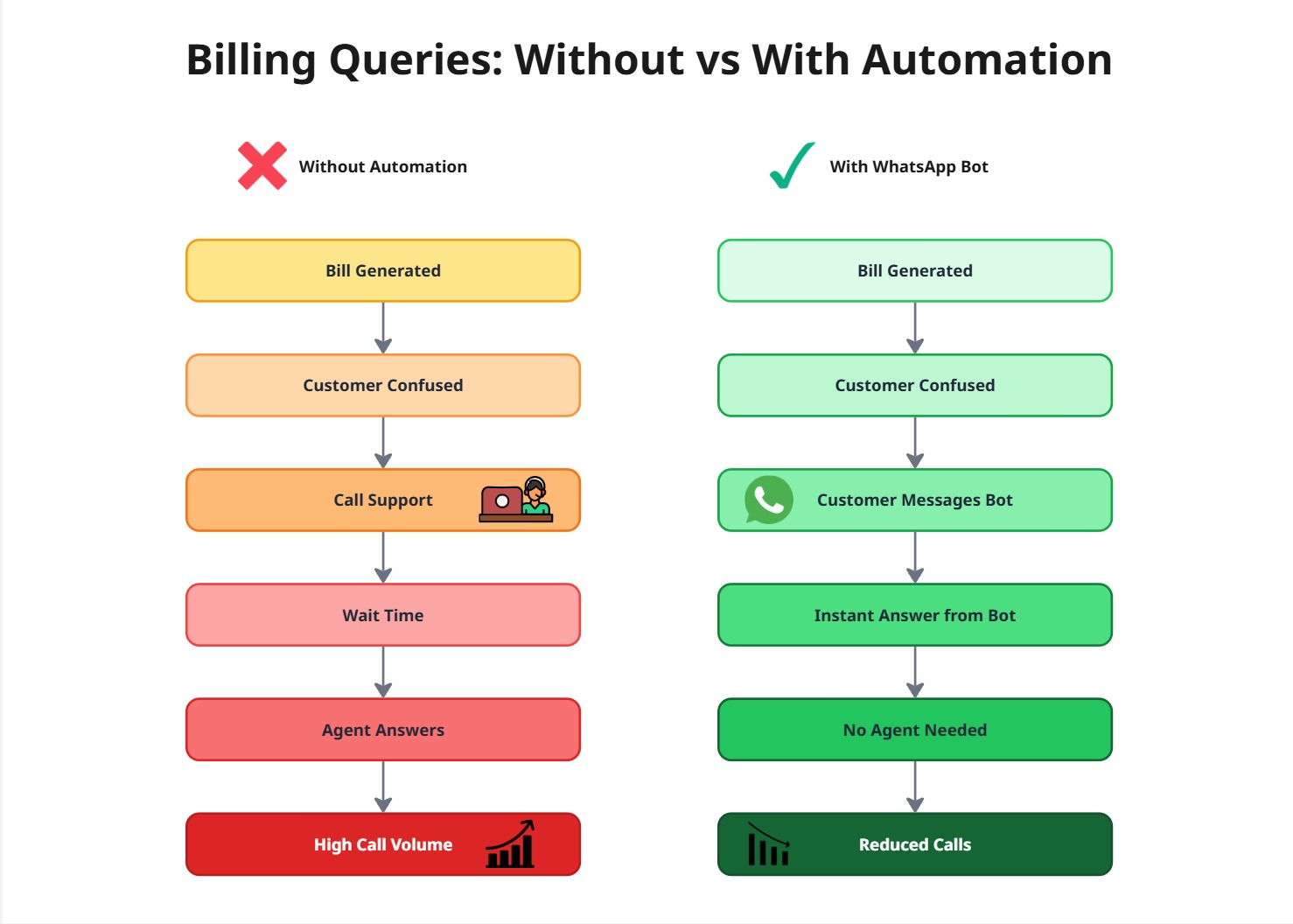
You know this one well. The moment bills go out, the inbox fills up. “Why is my bill so high?” “What’s this charge I don’t recognise?” “Did something change in my plan?” Your agents have answered these questions so many times that they could do it in their sleep. And honestly, they probably feel like they are.
The thing is, none of these questions requires a human. They require accurate account information delivered quickly. A WhatsApp bot for telecom billing does exactly that. Customer sends a message, the bot checks the account, explains the charges in plain language, and the conversation is done before an agent even has to glance at the queue. No hold music. No ticket. Just an answer. Done right, this kind of automation can shave 30 to 40 per cent off your billing-related call volume. That’s a number worth paying attention to.
2. The new SIM that needs to work right now
Picture someone who just picked up a new SIM on their lunch break. They get home, pop it in, and nothing works. They want it activated. Not tomorrow. Not after filling out a form on the internet and waiting for an email to confirm it. Right now, tonight, as they sit on their couch.
If your activation process requires a phone call during business hours, you’ve already lost them a little. That frustration sticks. The WhatsApp AI chatbot for telecom services walks them through the whole thing inside the chat itself. Collects what it needs. Verifies their details. Either activates the SIM automatically or passes everything to the backend with zero re-entry required. The same goes for plan upgrades. The customer chooses, confirms, done. Your agent’s name never came up.
3. When the tower goes down, everyone panics at once.
This one is chaos if you’re not prepared. A tower goes down, and within minutes, every customer in that area is messaging, calling, tweeting, and posting about it. Your support team can’t physically respond to all of them fast enough. So most people get silence. And silence during an outage makes people angrier than the outage itself.
Here’s where telecom customer support automation genuinely pays for itself. The moment a network issue is detected, the WhatsApp AI chatbot in the telecom industry can proactively reach out to affected customers before the complaints even start. And for the ones who message in any way, the bot already has the update ready. What’s down? What’s being done. When will it be back? One message, thousands of customers, no agent required. Most telecom companies wait for the storm to hit before they respond. Getting ahead of it is the move almost nobody makes, and it shows.
4. The roaming question at 11 PM before a 6 AM flight
Someone is frantically packing for an international trip and just realised they have no idea what their roaming situation looks like. They message your support line. If the answer takes until morning, they’re boarding that flight with zero clarity. And when they land to a surprise bill, the trust is gone.
The WhatsApp AI chatbot for telecom services doesn’t have office hours. It answers the roaming question at 1 AM the same way it would at 11 AM. Accurately, quickly, without making the customer wait. It can even help them add an international pack right there in the conversation, before they go to sleep, before they board, before there’s any chance of an unpleasant surprise. That’s the kind of support people actually remember.
5. Everything that comes in after your team logs off
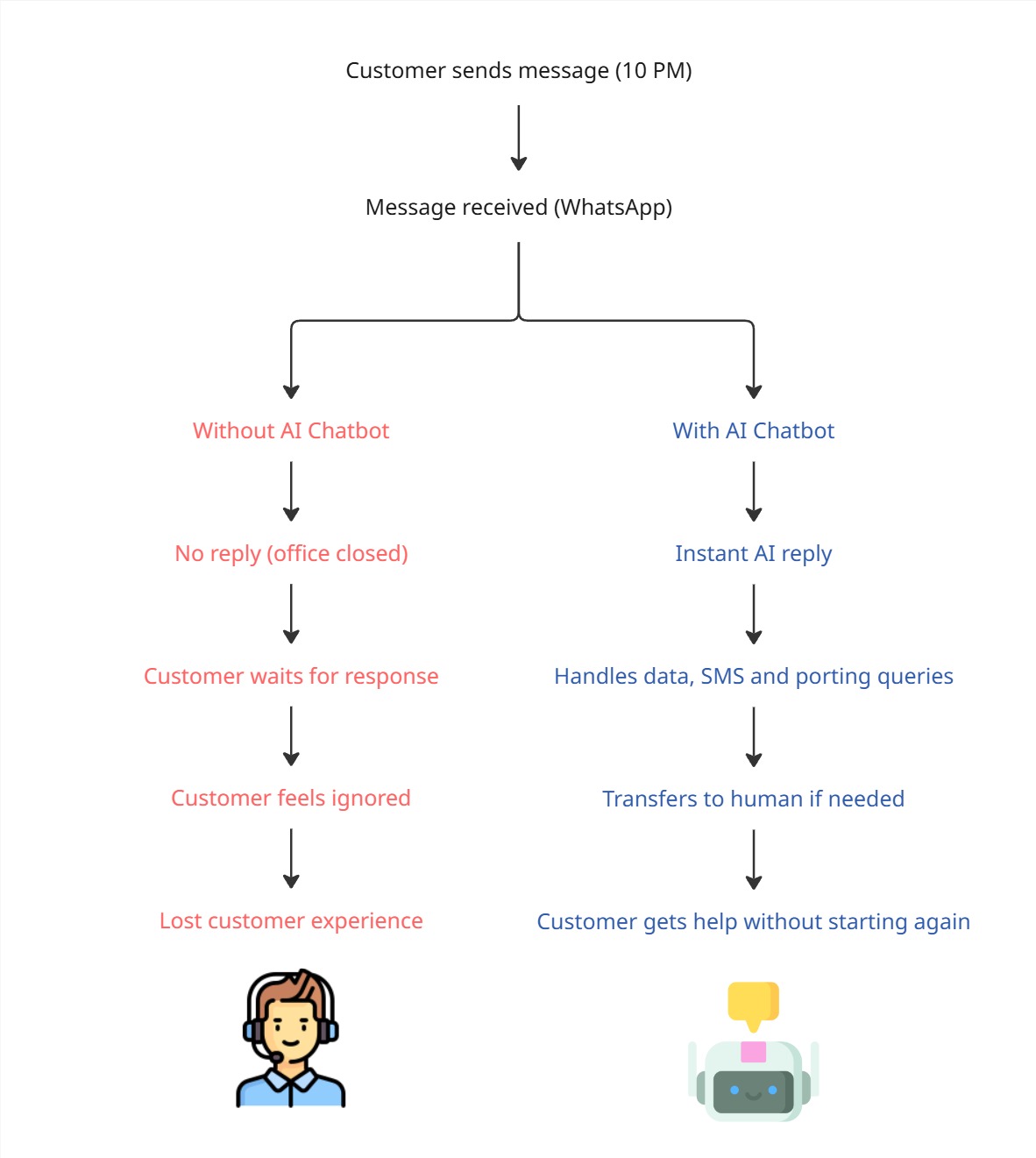
Your call centre closes. Your customers don’t. Someone’s data stops working at midnight. Someone else gets a confusing SMS about their plan at 10 PM and has questions. Another person wants to port their number and starts the process on a Sunday evening.
All of these people are going to message you. What they get back determines whether they feel taken care of or ignored. In the telecom sector, the WhatsApp AI chatbot works non-stop, sorts out what it can do all by itself, and once it has exhausted its capabilities and there is something that really requires human intervention, it transfers the context to the person who will respond without making your customer start again from the very beginning the following day.
The Monday morning that looked different
Three weeks after setting up the WhatsApp AI chatbot for Priya’s telecom industry, Priya’s Monday morning looks different. The queue that used to sit at 340 unread messages is now a fraction of that. The overnight roaming queries are answered. The billing questions from the weekend are resolved. Her team walks in and actually has time to handle the things that genuinely need a human.
Remember the customer who ported their number by lunchtime? With a chatbot, that story ends differently, because the 1 AM message gets a real, useful reply within seconds. Not silent until someone logs in eight hours later.
That’s the whole point. Not every support interaction needs to be remarkable. Most of them just need not to be slow. If you respond quickly and accurately at 1 AM, you can stop someone from quietly leaving.
Conclusion
Every 34-minute hold time is a customer reconsidering their loyalty. Every unanswered midnight message is someone who woke up the next morning and searched “best telecom plans near me.” Every roaming bill surprise is a complaint on a public forum.
None of this has to happen. Telecom customer support automation through WhatsApp doesn’t require a massive overhaul of your support team. It sits on top of what you already have and takes care of the volume that was overwhelming your people in the first place.
Your WhatsApp number can either be a channel nobody checks, or it can be the support touchpoint your customers actually prefer. The difference is just whether you’ve put the right system behind it.
If you want to get a WhatsApp AI chatbot in the telecom industry running without building it all from scratch, Agentzee is worth a look.
The workflow is already figured out. You just have to switch it on.