
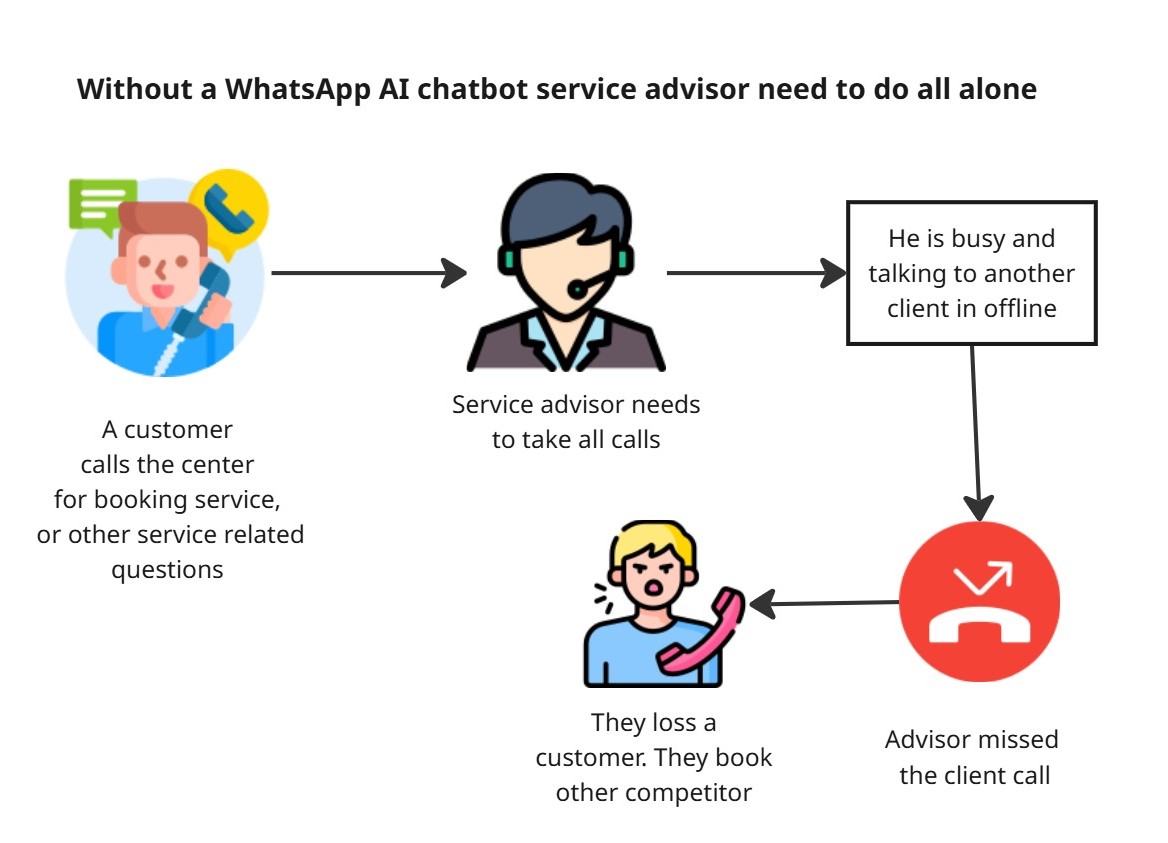
It’s a Monday morning at 9 AM in a busy automobile service centre. The service bay has four cars waiting for regular service. The phone starts ringing at 9.30 AM. One service advisor is handling three customers at the counter. Another advisor is already in a call with a customer. The third advisor is chasing yesterday’s job cards.
The person called 2 times. They just want to book a weekend slot. But they hung up after the third ring because no one answered. They booked with another branch service centre. Another person calls. Finally the advisor picks up the call after 10 minutes. They want to book a service for next Saturday and the advisor asks for the car model, the last service date, the registration number, and the preferred time for service. But the customer forgot the last service date. It took 12 minutes to find it from their service registry.
Multiply that across 20-30 service requests per day. The advisor needs to handle all follow-ups to confirm slots, a reminder call two days before, and post-service call feedback that nobody ever actually makes. This is how most car service centres, from small to multi-brand authorized dealers, operate today. This process is manual and slow, needs an advisor’s time, and loses upsell opportunities.
Customers today don’t want to call. They just need a message for reminders. Today everyone is using WhatsApp. Let’s see how the WhatsApp AI chatbot helps automobile service centres automate their messaging workflows.
What a manual process actually looks like today
Before getting into the solution, let’s discuss what the current process actually costs. Most of the car service centres track bookings via phone calls and a whiteboard. Even somewhere service advisors use WhatsApp, a person manually texts the customers or uses Google Sheets. Service reminders are sent manually. Feedback collected via the form at the counter.
A customer who called but didn’t get a response from the service centre moved to another option. And a customer whose service was due four days ago, but nobody reminded them. A customer had a small complaint, but never got a reply to a message from the advisor. These are the invisible losses.
User-friendly WhatsApp AI chatbot
WhatsApp has over 500 million active users in India alone. Most of the businesses contact their customers through WhatsApp. It’s where people talk to their family and confirm plans, and, increasingly, handle service requests.
A WhatsApp AI chatbot for a car service centre doesn’t ask customers to download an app or navigate to the booking portal. It meets customers exactly where they already are. If a customer asks to service their car, then the WhatsApp AI chatbot takes over the conversation and collects vehicle data, confirms slots, sends reminders, and requests feedback after their job is done. All on WhatsApp. All automated. Without advisor interaction, chatbots make all replies on time.
How a WhatsApp AI chatbot works at car service centres
Let’s see how a WhatsApp AI chatbot helps car service centres automate their messages and reverse their loss.
1. Capture vehicle and customer details automatically.
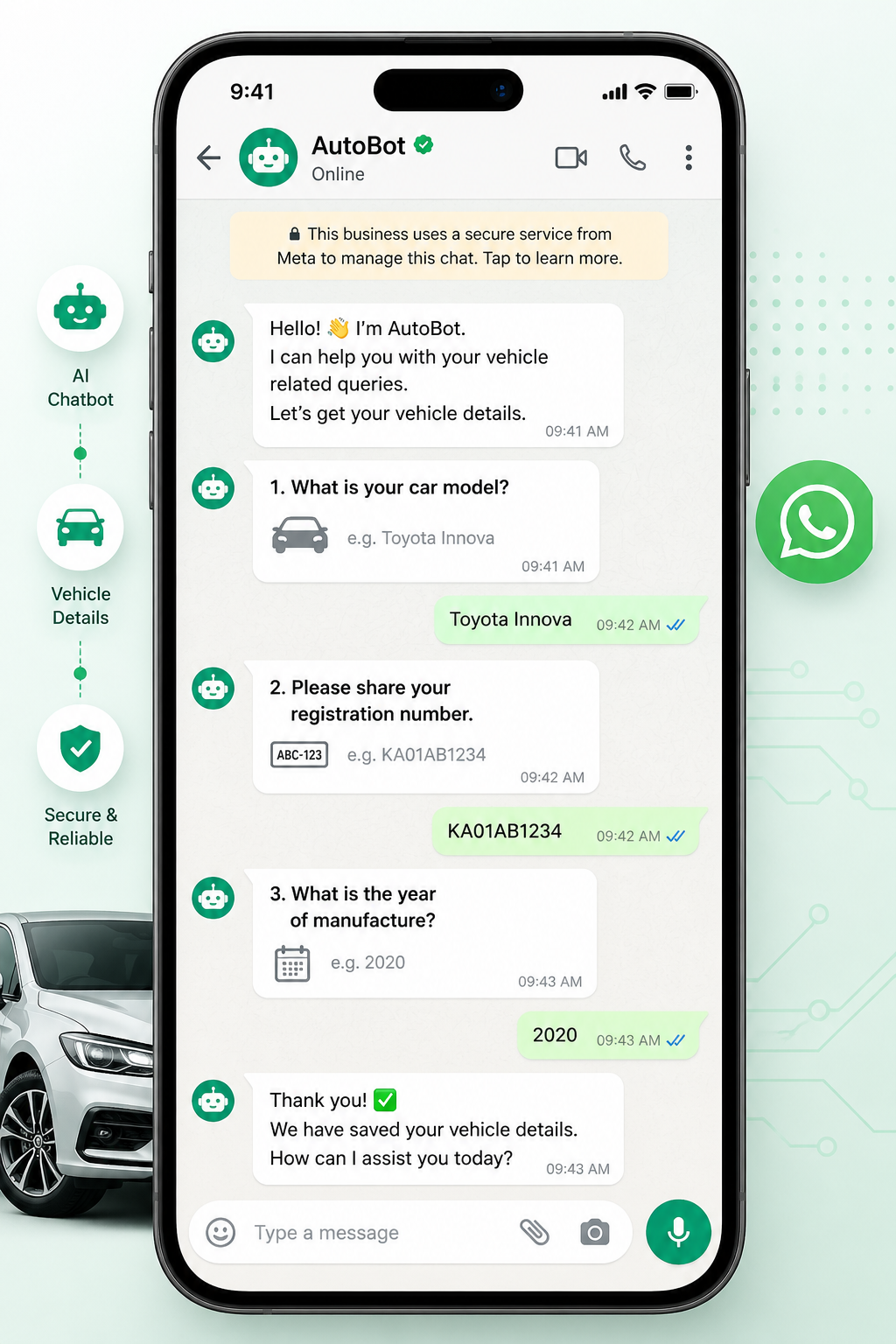
After setting up the WhatsApp AI chatbot for the car service management system, it starts collecting details from the customer.
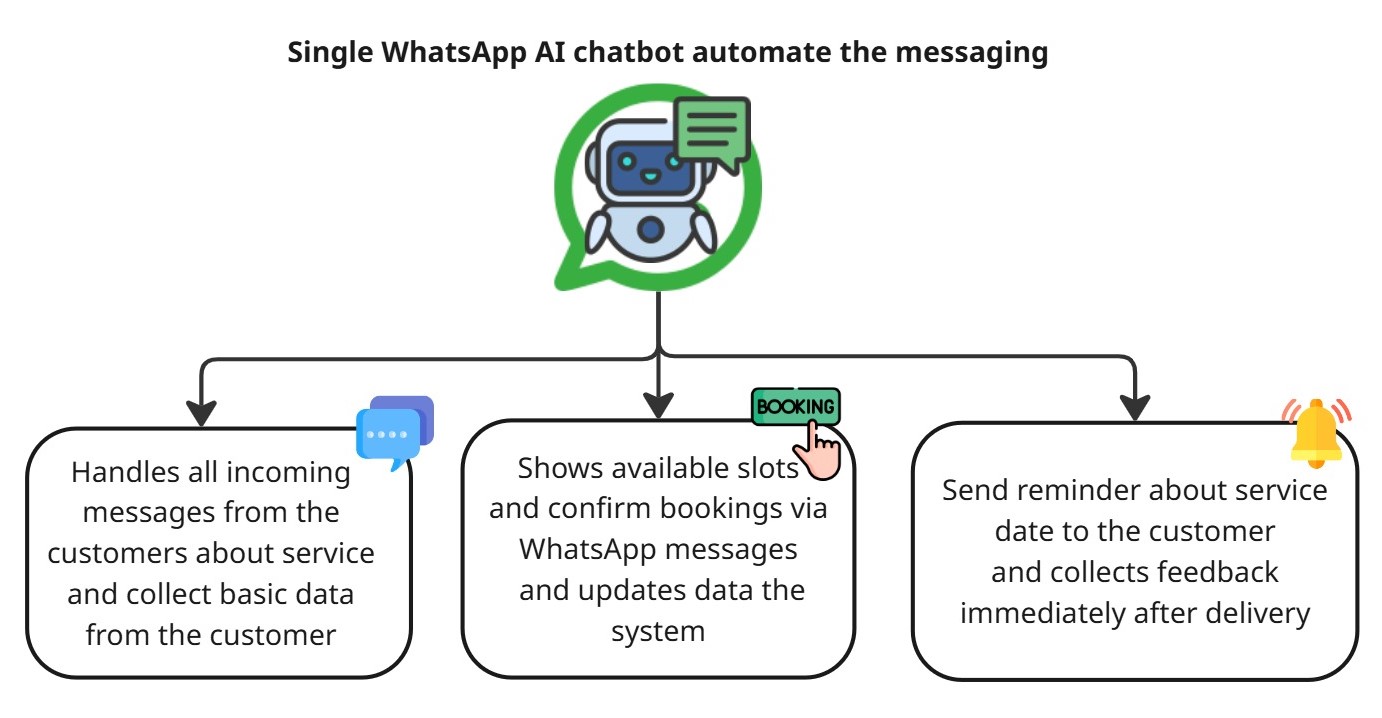
When a customer is reaching out to us via the WhatsApp number, pasting the service bay, or from the website, a bot immediately activates and starts replying to them. If a customer starts with a question like “Can I book a service tomorrow?” then firstly, the bot greets them and collects information from them if any slots are available. Otherwise, it replies with the available time.
It asks relevant questions like car model, registration number, address, current mileage, and the service required, like periodic maintenance, specific complaint, insurance repair, etc. This data is stored with the customer number in the database maintenance system or any kind of CRM for later use. Collect crucial data with a bot, and collect the rest of the data at check-in. Here there is no manual data entry. Crucial data is collected before the customer’s arrival. No information gaps.
2. Book a right slot without a phone call
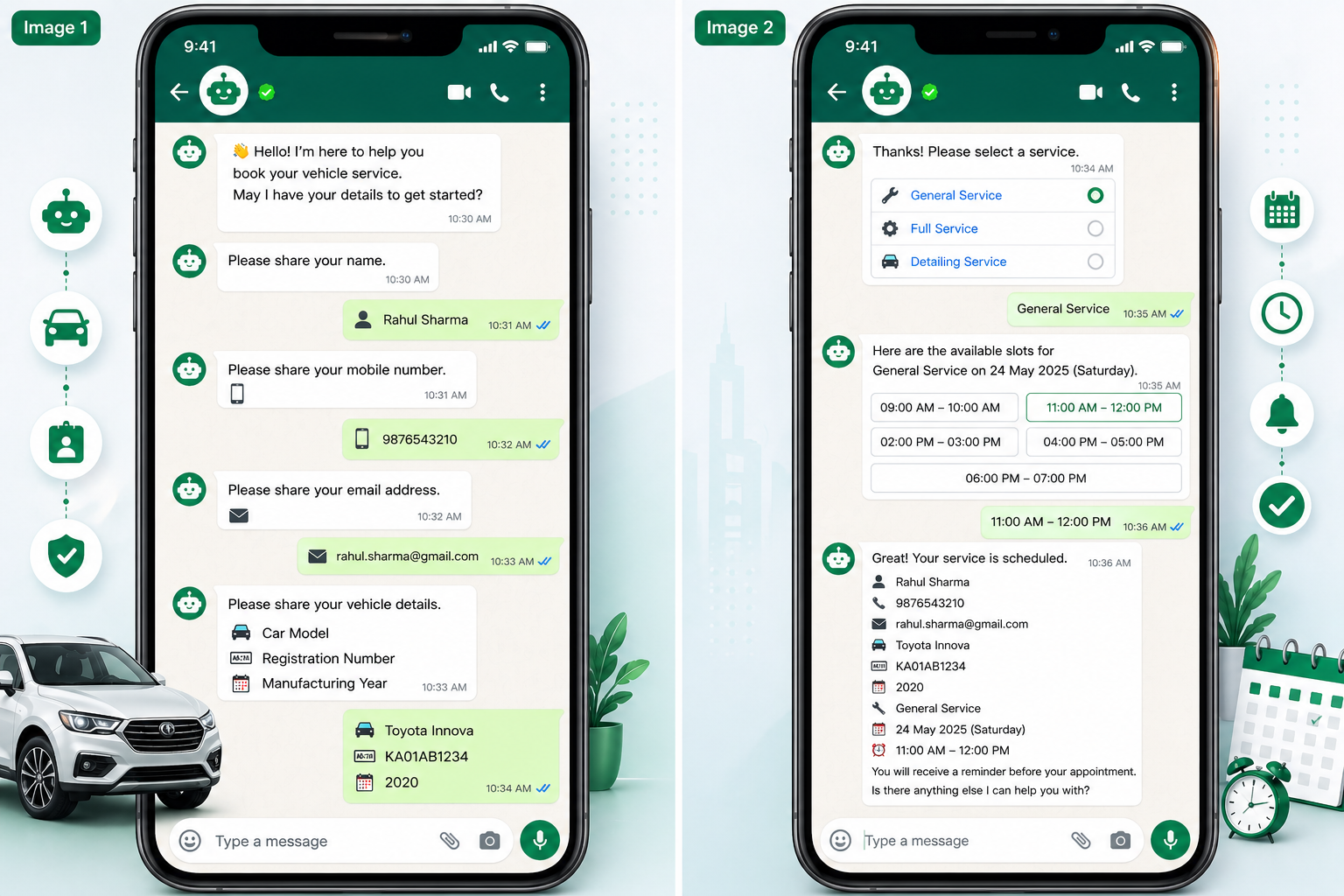
Integrating the WhatsApp AI chatbot with the service bay calendar helps to present the available slots to the customer and book a service at the available time automatically. This is where most car service centres save the most time.
The chatbot checks the real-time slot availability and shows the customer two or three options. As per the customer’s choice, it confirms the slot. After it can be stored in your database or CRM, like a storage platform. The slot is booked in the system. All within a two-to-three-minute message.
The confirmation message is sent to the customer chat. And before confirmation, it asks for some more information about the vehicle. There is no need for an advisor to show available slots to the customers.
Before: The advisor calls the customer, or the customer calls the advisor, to discuss the available slots for service and confirmation.
After: The entire booking flow completes in a few minutes.
3. Send automated service reminders before the customer even thinks to call
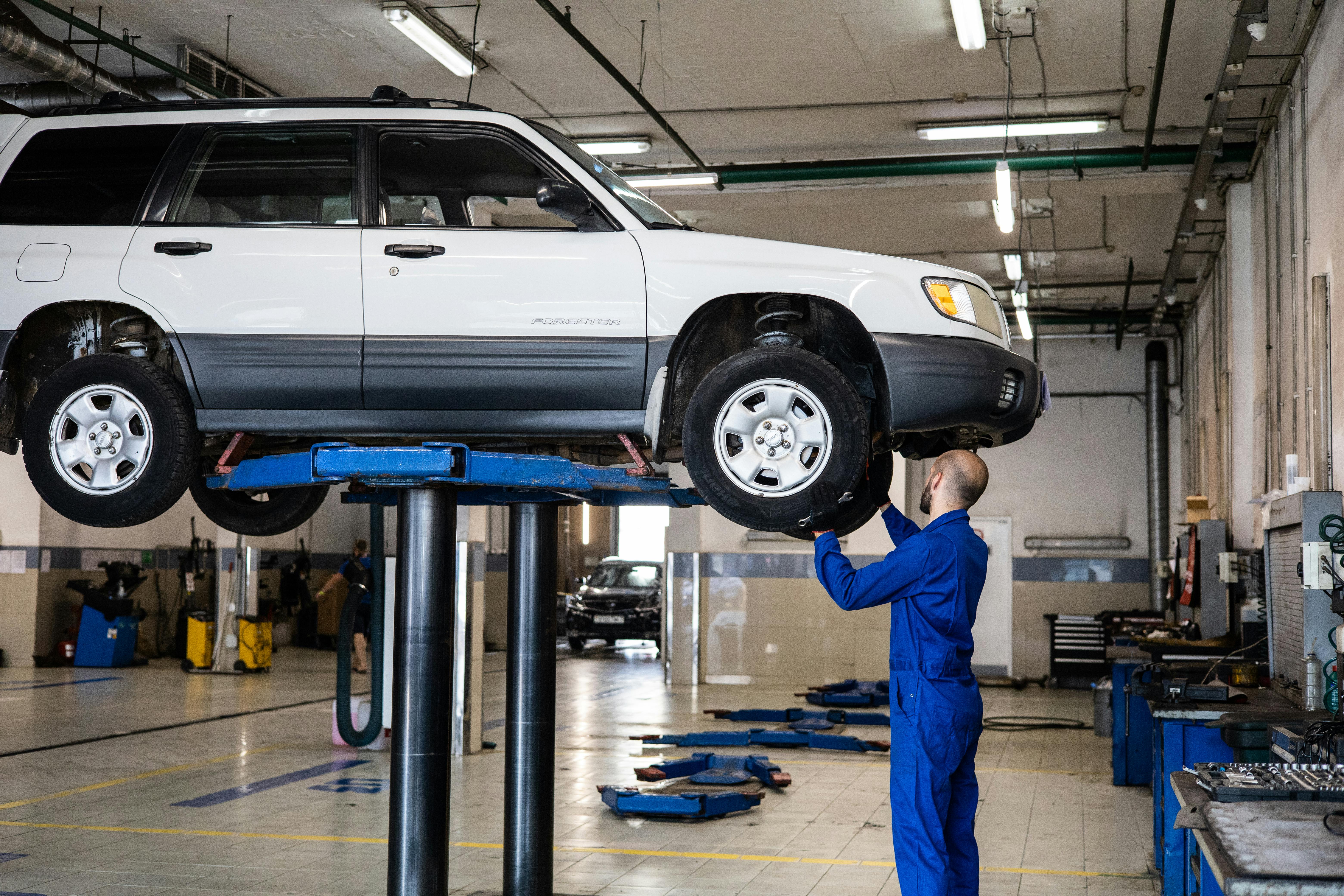
Most of the car service centres wait for the customers’ remembrance of their car service due. That’s a losing strategy. If a person bought a car before six months and forgot to get the first service, it will be their loss. There may be any fault that happens. Then the service advisor of the showroom calls them after a month to remind them about the first service.
The WhatsApp AI chatbot changes the situation. For this, it should load the customer’s buying date or the last service due date. From that date, after six months, it should send the reminder at least two days before. Store the date when they first used the chatbot. It automatically sends the WhatsApp message when the next service window approaches.
After sending the reminder, it also shows the available slots and books the service date for the customer. “Hi Ramesh, your Mercedes car’s last service date was more than six months ago. It’s a gentle reminder of your car service.”
The customer doesn’t have to think about it. The prompt lands at the right moment. Conversion rates on these proactive messages are significantly high.
Note: In advance, you can send reminders via email or SMS to the customer.
4. Collect Post-service feedback while it’s still fresh
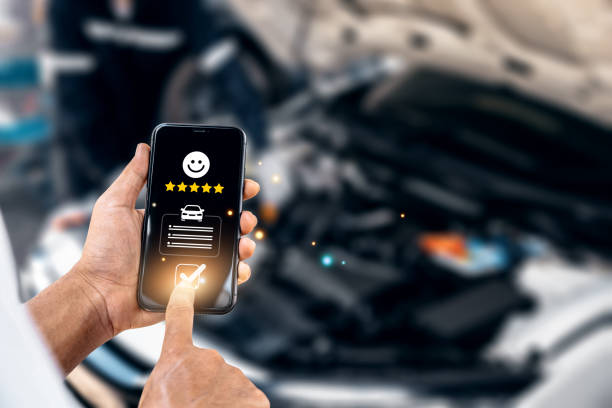
Triggering the post-service feedback message two to three hours after the car service delivery is crucial. Not the next day. Feedback collected on the same day is worth ten times more than collected a week later. Most of the automobile service centres ask for feedback too late, or on the wrong channel, or sometimes forget to.
The WhatsApp AI chatbot sends a short and responsive message shortly after delivery, with a quick rating and an optional comment. Because of this feedback, we can get problems addressed before they become public complaints.
Note: Always ensure you do not trigger the feedback message before confirming the delivery in the system. Because it becomes embarrassing and damages trust.
Our Agentzee will make your messaging automation easy.
How Agentzee helps you to automate your messages
Agentzee is here to make it faster and more flexible for your needs. Creating templates for WhatsApp messages needs time. If you configure a WhatsApp AI chatbot from Agentzee, you don’t need to worry about any technical part. We did all the tough parts for our customers’ ease of access.
Honestly, this WhatsApp AI chatbot is not for replacing a service advisor. Our main goal is to make things faster and automate repetitive work. Because for some crucial part, definitely a person’s involvement is needed. For insurance disputes after service, or one who is simply frustrated and needs to talk to a person.
A WhatsApp AI chatbot’s job is to handle the high-frequency and low-complexity interactions so the advisor has the time and the headspace to handle the ones that actually need them.
Many customers still prefer to call. If that’s true for your centre, an AI inbound voice agent for car service centres can answer those calls and book slots in the same way.
Conclusion
Every automobile service centre that still depends on manual phone calls and manual follow-ups. Missed bookings may lead to losing customers and result in a loss of revenue. Upsells that never happened. Campaigns that never got resolved, and some repeated customers drifted to a competitor because nobody reminded them their service was due.
In Agentzee, a WhatsApp AI chatbot changes your strategy. It doesn’t change what a service centre does. It changes how reliably it gets done. The car service centre that runs this kind of workflow doesn’t just look more professional. It earns a repeat customer visit because they never had a reason to look elsewhere.
To know more about the WhatsApp AI chatbot, just take a tour of our product Agentzee