
More than 70% of internet buyers put items in their carts but never complete the transaction. The majority only require a timely, intimate prodding. With open rates exceeding 85% and recovery rates rising, a WhatsApp AI chatbot provides that nudge on the platform users already use on a daily basis.
Recovery rates of up to 25% of abandoned carts are possible, which is much better than email.
Details such as name, phone number, and much more of a customer are provided by them while they sign up on our website. Sometimes, they are even happy to participate in a WhatsApp campaign.
Random stuff they browse on the internet is added to a cart every now and then. Your backend records every cart event connected to their profile.
The cart is marked as abandoned after one to two hours of inactivity without checkout.
Your personalised, conversational, and conversion-focused WhatsApp AI chatbot starts a weekly message sequence.
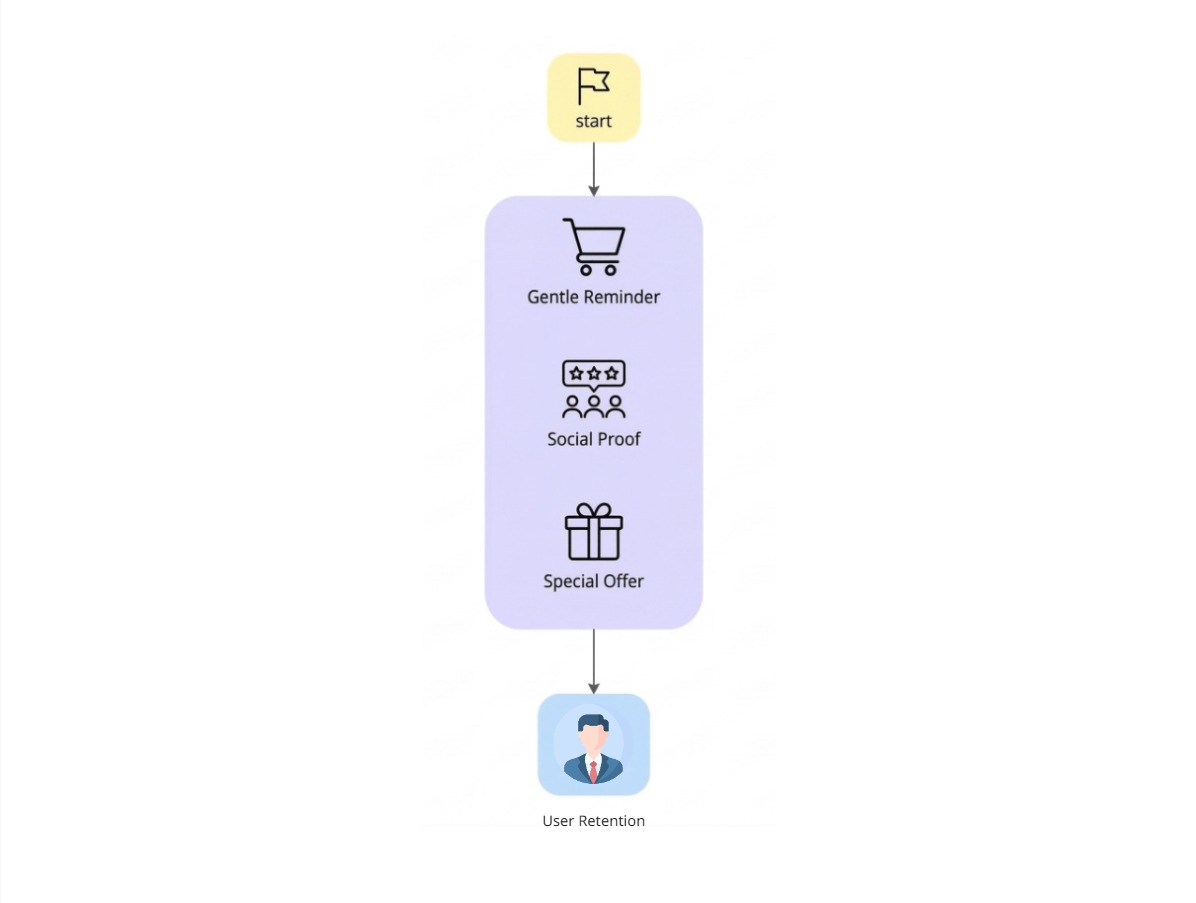
The Message Sequence for Each Week
Focuses on a distinct buying objection every week:
Week 1: A gentle reminder alongside their name, reminding them about the products in their cart, and a direct link to the user’s checkout page.
Week 2: Reviews as social proof are provided. These are basically star ratings and a customer quote about the most frequently purchased or viewed item in their cart.
Week 3: Scarcity is highlighted by a low stock alert notification with a cart reservation notice.
Week 4: Exclusive deal. That is a personalised coupon valid for 48 hours. If a purchase is made, the consumer is automatically removed from the sequence.
Technical Execution:
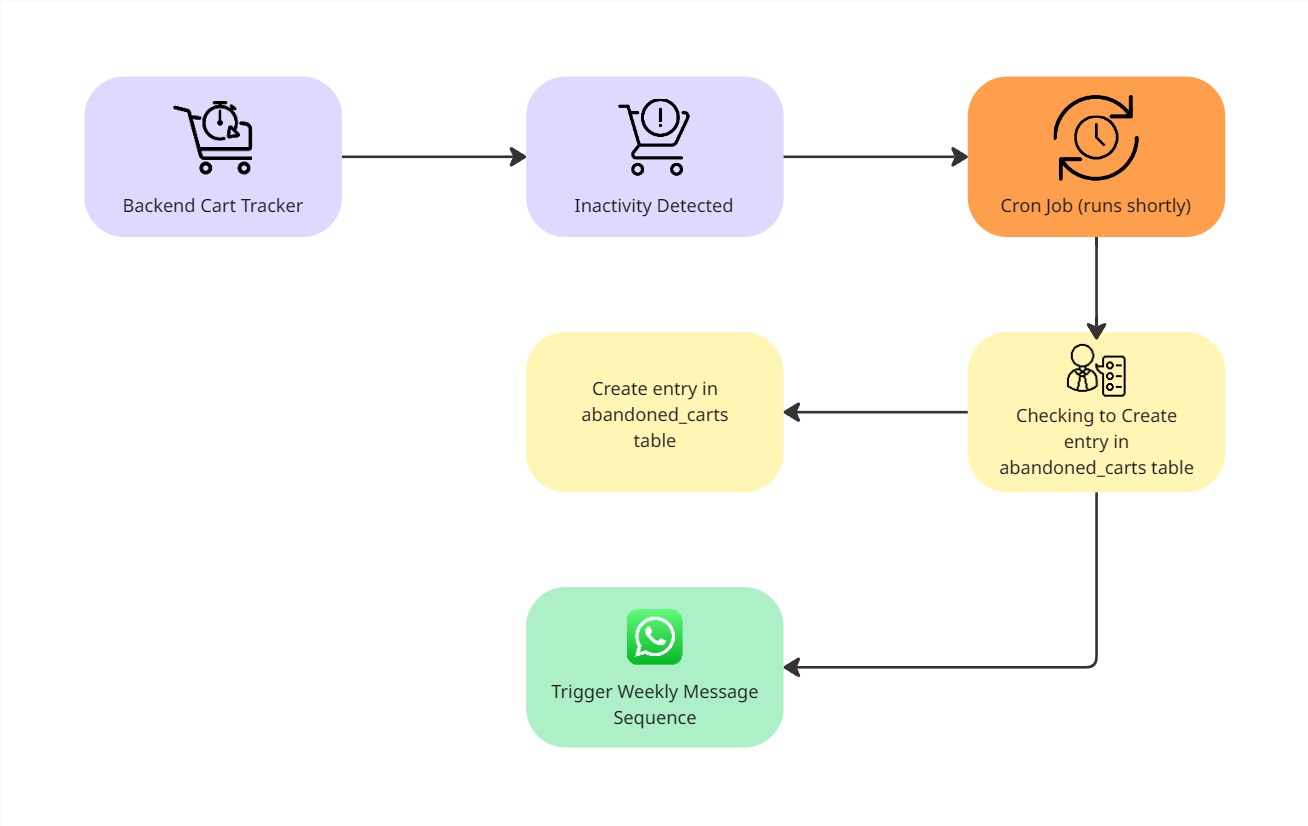
Three parts make up the automation: a weekly scheduler, an abandoned cart detector, and a cart tracker.
Keeping track of cart events.
A POST API call will be made whenever a user adds a product to their cart. The backend will be sent with a payload with all the available details, such as user ID, product details, and timestamp. These data are stored for further implementations.
Look for abandoned carts.

For every hour, carts that haven’t been active for more than an hour are checked by a cron job. Whenever it finds one, it adds its record to the abandoned_carts table.
A scheduler for weekly retention.
Every day at 10 in the morning, the cron job schedules messages. This is sent using the WhatsApp Business API. The cron job scheduler determines which abandoned_carts are scheduled for their next message.
An AI chatbot responds to you.
A webhook is triggered when a user replies. To be able to give a helpful, conversational response, the WhatsApp AI chatbot retrieves the customer’s cart context and makes a call to the Claude API. This allows us to deal with objections and automatically convince the user to check out.
Purchase recognition.
The process is halted right away when an order is finished, given that the cart items have been removed and the abandoned cart data is set to “recovered.”
Workflow Architecture: Overview
When someone signs up for our website, we save their phone number, contact information, and permission to get promotions in our database.
The details of the product that a user adds to their cart are also updated in the cart items table.
The cron’s hourly detection job is always looking for carts that haven’t been used in more than an hour and then adds them to a list that has all the abandoned carts.
Every day at 10 AM, this daily scheduler looks for the records in abandoned_carts. 9. The Meta APIs allow our WhatsApp call to send a pre-approved template message to the user’s phone.
After that, whenever a user responds to the template message we sent, a webhook event is triggered. This event provides all the usable information about the message sent. Next, a contextual response is given by our WhatsApp AI chatbot using the Claude API, grounded in the customer’s cart details.
Every time a user completes a purchase, their shopping cart is cleared, and their abandoned cart is marked as “recovered.”
After 4 messages regarding the cart items being left alone, no purchase was made. The status is set to ‘expired,’ and users will be directed to the re-engagement pool.
Metrics to Measure Success:
Starting from day one, your system should be set up such that you can see what’s working and what’s not. This will help you find areas and help you set up your system better.
Cart Recovery Rate: The rate of the number of recovered carts. That is the (number of recovered carts x 100 / total abandoned carts)
Click-Through Rate: Users who clicked through the cart link we sent.
Message Open Rate: The rate of users who checked the messages can be seen using WhatsApp read receipts.
The Opt-Out Rate: These users block or stop receiving your WhatsApp messages. Never go over 2%. Messages that are frequently sent or irrelevant are detected with a high opt-out rate.
Total Revenue Recovered: the complete GMV linked to the recovery sequence.
AI Chatbot Resolution Rate: The number of user enquiries resolved without involving humans in a conversation. 70% is the target here.
Essentials in Compliance
• At the time of sign-up, collect explicit consent to WhatsApp opt-in.
• For outgoing messages, only use message templates that have already been approved by Meta.
• Be considerate towards requests that opt out right away, and never send a message after 9 p.m. local time.
Conclusion
Paused decisions, not lost sales, are what cause abandoned carts. With the help of automated detection, a four-week recovery period, and real-time AI responses, a WhatsApp AI chatbot converts those pauses into purchases without the need for human intervention. Once you set it up, it operates in the background of your store as a silent revenue generator.
You must already be eager to put this into practice if you have read this far, right?
Let me offer you a simpler solution, which is Agentzee.