
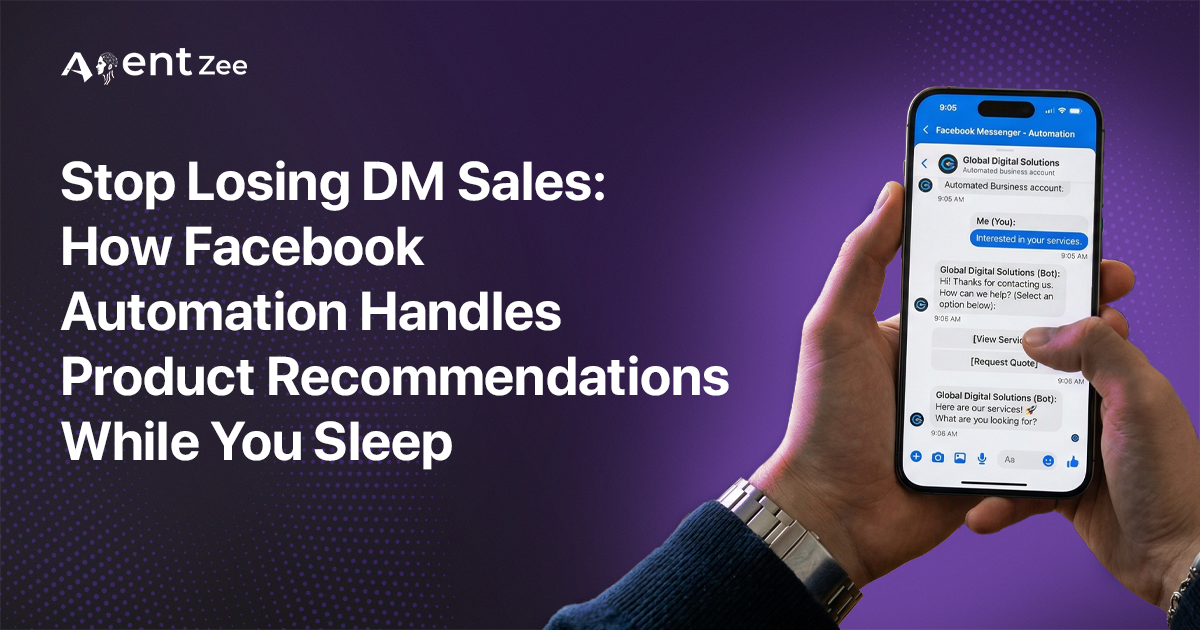
Amara runs a skincare brand out of Chennai. Her products are good. A sunscreen formulated specifically for South and Southeast Asian skin tones, built around one promise: preserve your natural complexion, don’t bleach it.
She posts on Facebook. The DM blew up.
“Which one is right for my skin?”
“I work outside all day. What do you recommend?”
I have oily skin. Will this work for me?”
Her sales team of three tries to keep up. By hour two, they’re copying and pasting the same answers. By hour four, two of them have given up and gone to get coffee. By the next morning, forty potential customers are still waiting.
This isn’t a staffing problem. It is a systems problem. Amara, along with thousands of other brands, found a solution in Facebook automation.
Why your sales team can’t scale the way your audience can
Here’s the uncomfortable truth about human sales agents: they are brilliant, but they are finite.
One person can manage maybe three to five conversations at once before quality suffers. When someone in Mumbai is going through their feed at two in the morning 🌃, they cannot work. Also, it is not possible to hire quickly enough to meet demand in real-time when a campaign goes viral, such as with Amara.
The math doesn’t work. You either miss sales or you burn your team out. Neither is a good business strategy.
What customers actually want in the moment is simple: a fast, relevant answer that helps them decide. They don’t need a human for that. They need a smart conversation that asks the right questions and points them to the right product.
That’s exactly what Facebook automation does.
How Facebook chatbot automation works for product recommendations
Think of it less like a bot and more like your best-trained sales rep, one who never sleeps, never has a bad day, and can handle five hundred conversations simultaneously without mixing up a single customer’s skin type.
Here’s how Amara set up her Facebook automation system:
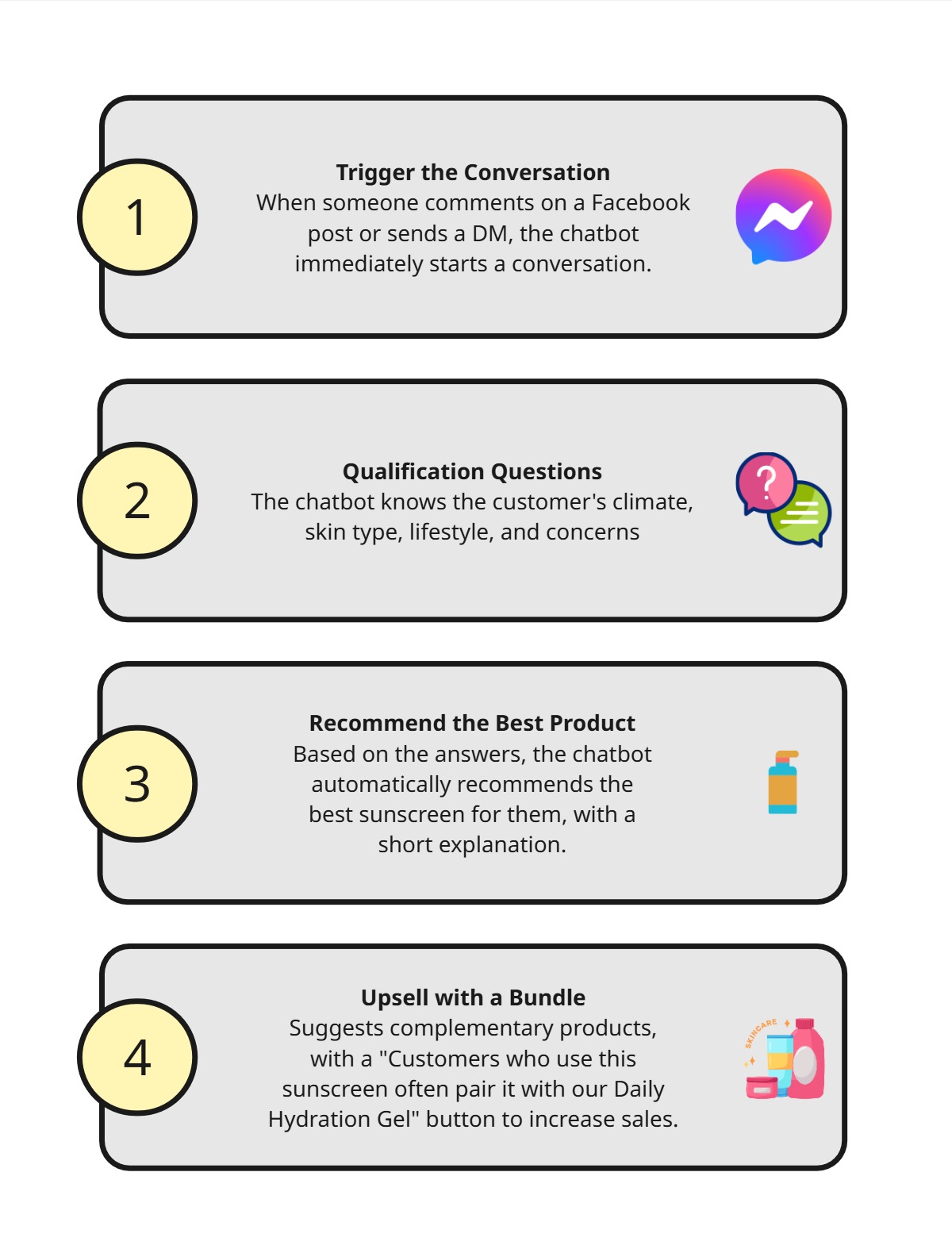
Step 1: Trigger the conversation from engagement.
When someone comments on a Facebook post or sends a DM, the Facebook automation kicks in immediately. No waiting. In the attention-based world, a response in a matter of seconds is all that counts.
Step 2: Start with the right qualification questions
Instead of pushing a product immediately, the Facebook automation does what a good sales rep would do:
It asks questions.
For Amara’s brand, the flow looked like this:
Which region are you based in?
What’s your age range?
What is your work nature 💼?
What is your skin type 👱?
How many hours in a day are you exposed to direct sunlight ☀️?
What is your current skin concern?
Six questions. The whole conversation takes under two minutes. But by the end of it, the Facebook automation system knows the customer’s climate, skin type, lifestyle, and concerns. It is enough to make a recommendation that feels like it came from a dermatologist, not a dropdown menu.
That’s the real power of Facebook automation done right. Not broadcasting. Listening first, then recommending.
Step 3: Match the answer to the right product
Based on the responses, the automation cross-references a product logic map and surfaces the best recommendation, with a short explanation of why this product fits them. “You’re based in Chennai, work outside, and have oily skin. Our SPF 50 Matte Shield is made for exactly this. It won’t clog pores and holds up in 35°C heat.” That specificity of Facebook automation is what converts browsers into buyers.
Step 4: Recommending a bundle
Here’s where smart brands are leaving money on the table if they’re not paying attention. The recommendation does not stop at just one product.
For instance, a smart Facebook automation flow may suggest a sunscreen and also recommend a cleanser, moisturizer, and a serum.
The recommendation should not be in an aggressive way, but in a helpful way. For instance, “Customers who use this sunscreen often pair it with our Daily Hydration Gel.”
Two to three complementary products, presented as a routine rather than a sales push. That’s the difference between feeling helped and feeling sold to.
Does Facebook automation actually work for product recommendations?
Yes, it’s a surprising result to most people who have not witnessed it in action. Automated recommendation systems will always beat generic broadcast messages because they are based on what the individual said, not what a brand wants to say.
If a customer feels that you understand their unique situation, then conversion rates will be higher. Response times go down to seconds. And your team’s energy is focused on the conversations that really require a human: escalations, complex complaints, wholesale enquiries, etc.
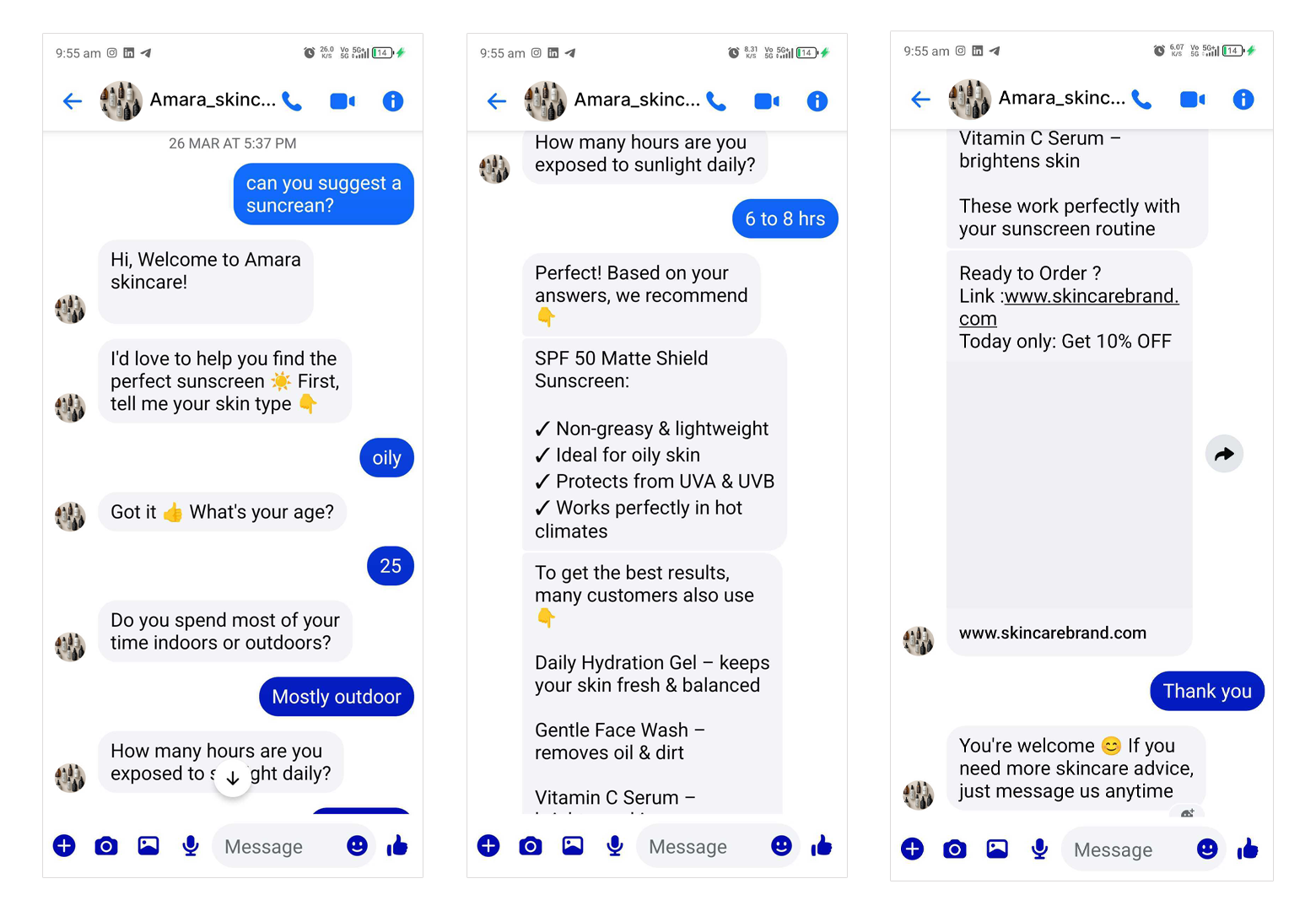
For Amara, the impact was straightforward. She went from three people scrambling to reply to comments to a system that handled the first five touchpoints of every customer journey automatically. Her team now steps in only when a customer has a nuanced question or a specific concern, the conversions that actually benefit from a human.
During her next campaigns, instead of 40 unanswered DMs, every single person got a response within 30 seconds. Conversion from DM to purchase went up. Her team stopped dreading product launch days because Facebook Automation handled the heavy lifting.
The brand didn’t grow because she hired more people. It grew because she stopped making customers wait.
The brand that listens first always wins
Amara didn’t build a bigger sales team. She built a smarter conversation with Facebook automation.
That’s the shift that deserves attention. The reality is, today’s customers aren’t lacking in choice. Every brand on their Facebook feed is competing for the same thirty seconds of their time. What actually breaks through isn’t the brand with the biggest marketing voice or ad spend. It’s the brand that makes them feel understood before asking them to buy.
A Facebook automation flow asks the right six questions and does something most brands still aren’t doing: it treats every customer as an individual, not a segment. The person in Chennai working outdoor 🏞️ sales meetings gets a different recommendation than the person in Kuala Lumpur working from home 🏠, as they should.
And while your competitors are still copying and pasting replies at midnight🌃, your system is already three questions deep into a conversation with a customer who’s ready to buy. The best part? This doesn’t require a large team, a developer on retainer, or months of setup. It requires that you know what your customers need to be asked and that you create a flow that asks it every time, without fail.
Agentzee enables you to use this kind of recommendation system for your brand without having to deal with the technical difficulties. Make your qualifying questions and link them to your merchandise. For you and your team, let the system handle the heavy lifting.
To turn your Facebook messages into intelligent, automated conversations that qualify and convert customers instantly, explore our AI chatbot.