
Maintaining goodwill is easy until you have offline customers.
In your daily life, in commercial centres, you might have probably seen offline stores maintaining goodwill among their customers, mostly regulars. When a regular of any shop walks in, they have a conversation that was left off somewhere, known only to them.
Why is that? Because that relationship carries memories. But, when a new customer walks in, it is usually a “What are you looking for?” or “How can I be of service to you?”

How can you replicate this digitally? It is mostly a no. But what if I tell you that a WhatsApp AI Chatbot can help achieve this? Yes, Agentzee always has a way.
Now, for us to get into this blog, let us consider what will happen when that same loyal customer reaches out to the same business, but on WhatsApp. In most cases, they land in a queue indistinguishable from a cold stranger’s enquiry. They repeat their preferences. They explain their history. The friction that the business eliminated in-person reappears in the digital channel, and it chips away at the goodwill that took years to build.
There’s a clear gap here, and this is exactly what a well-built WhatsApp enquiry funnel aims to fix. It’s not about flooding your regular customers with automation. It’s to create a system that quietly recognizes them, remembers past interactions, and responds in a way that feels natural and familiar.
When a WhatsApp AI Chatbot is designed with thoughtfulness, it can give the warmth of “we know you” of a loyal relationship. This can be maintained across thousands of simultaneous conversations. A returning customer shouldn’t feel like they’re just raising another support request. It should feel closer to walking into a place where someone actually recognizes them and picks up the conversation without starting from zero.
This write-up is for business owners, product folks, and growth teams who are tired of rigid chatbot flows that treat everyone the same.
The idea is very simple. Instead of having them go through the same generic steps over and over again, build something better for the people who trust you enough to come back to you.
The Problem - Why Generic Funnels Fail Your Best Customers
Most WhatsApp automation is for top-of-funnel, first-contact scenarios. That makes sense for volume; a lot of the incoming could be new enquiries. But when that same blanket experience is applied to a returning customer who has bought twelve times and referred three friends, something silently breaks. The most common failure points are in 4 categories:
Amnesia by Design
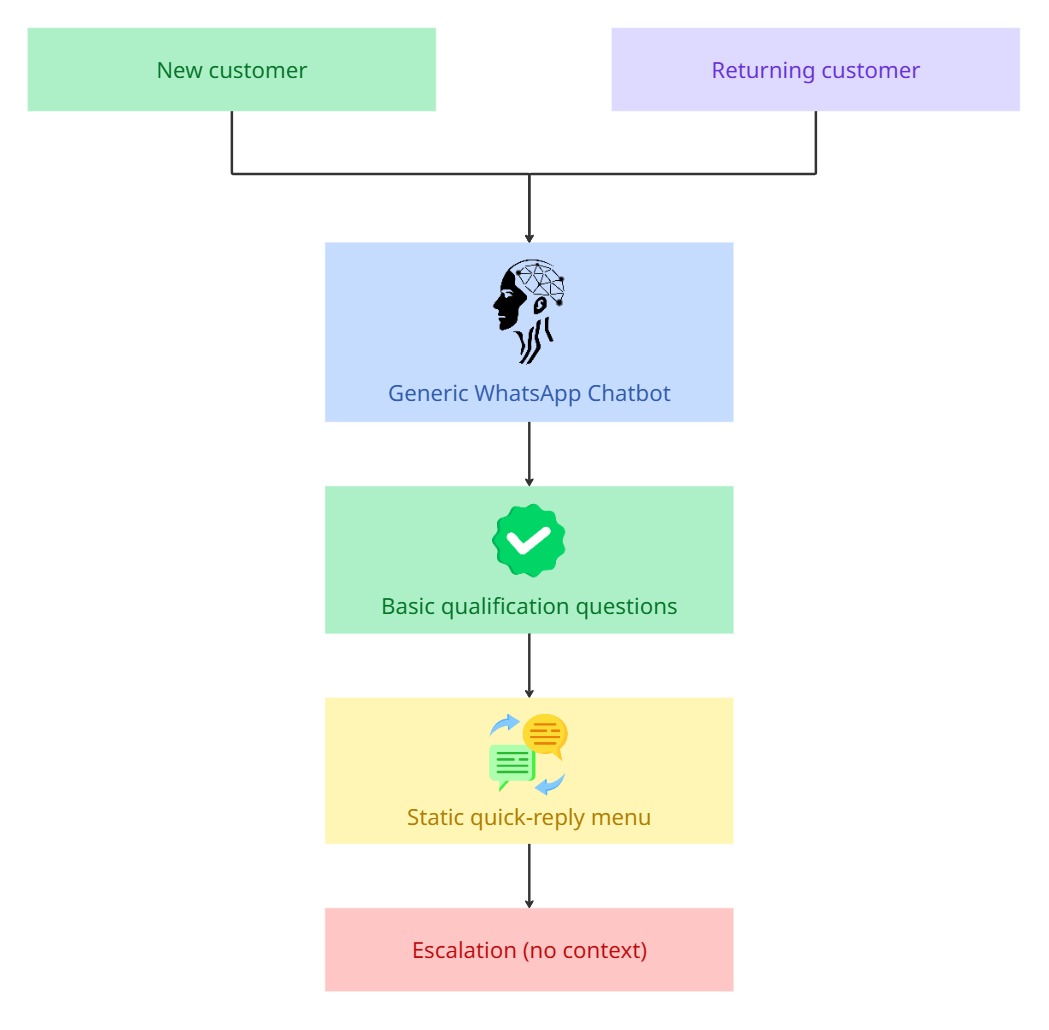
A generic WhatsApp AI Chatbot greets every user identically, forcing regulars through basic qualification questions they have answered before, erasing the history that makes them feel valued.
Context-Free Menus
Static quick-reply menus offer the same options regardless of who is asking. A returning customer looking for a repeat order is presented with the same “browse catalogue” option as a first-time visitor.
Missed Upsell Windows
At the moment of enquiry, the system does not have a purchase history, and therefore cannot offer intelligent suggestions of complementary products, seasonal re-orders or loyalty perks.
Escalation Without Context
When the bot hands off to a human agent, the agent gets no customer context, forcing the customer to repeat themselves, the very friction the automation was supposed to remove.
The architectural root cause for all of this is that the funnel was built to handle enquiries, not to recognise relationships. The volume was maxed out, but the loyalty was not.
That cost to the business is real. When the experience on WhatsApp fails to reflect that investment, regulars begin to feel like strangers and strangers, eventually, shop elsewhere.
There is also an operational cost. When loyal customers cannot self-serve efficiently because the bot doesn’t recognise their context, they escalate to human agents unnecessarily. This drives up support load on your highest-value customers, the opposite of what loyalty should produce.
The Solution - A Context-Aware Enquiry Funnel Powered by a WhatsApp AI Chatbot
The answer is not more menus or longer flows. A WhatsApp AI Chatbot shifts that logic from a stateless processing bot that processes messages, to a context-aware system that knows customers and adapts to their history in real time.
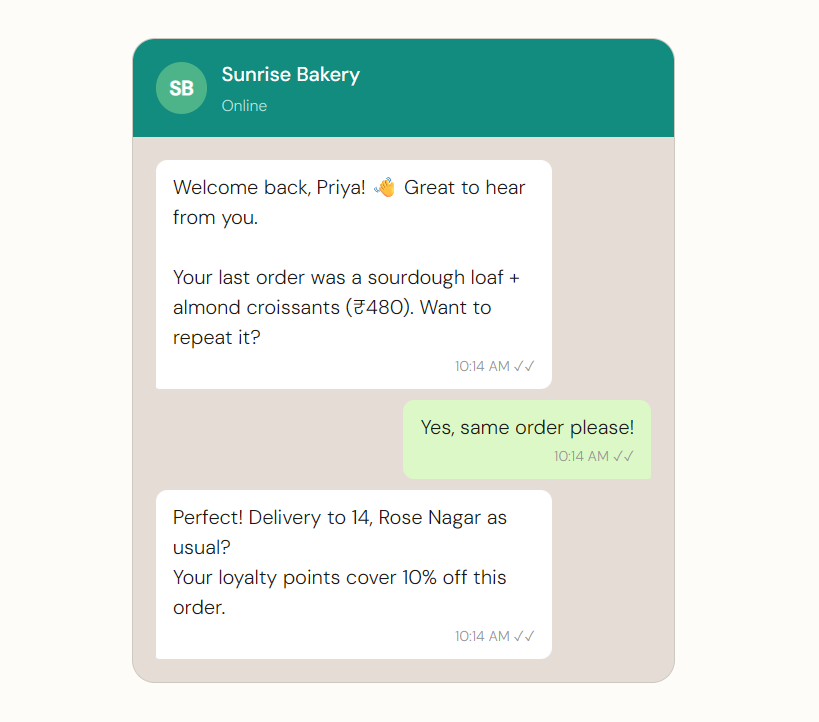
A WhatsApp AI Chatbot for repeat customers is built on a simple yet powerful premise: identity first, conversation second. It asks who is asking before answering. Against that identity, it determines how far it will go: fast-track options for regulars, exploratory menus for newcomers.
Why It Works
The returning-customer funnel reduces average enquiry resolution time by bypassing qualification steps that regulars have already completed. It also converts repeat purchases by showing the right options at the right time, based on purchase history, not guesswork.
A Guide on How to Build the Funnel: Six Guiding Steps
Here’s an organised approach to developing and executing an enquiry funnel on WhatsApp that truly helps loyal consumers. These actions are identical regardless of whether you are creating one from scratch or updating an existing chatbot setup.
Define Your Returning-Customer Segments
Not every returning customer is the same. Someone who ordered 6 months ago once has a different relationship profile than someone who orders every week. Define your categories before you start using any automated processes: first-time returning buyers, occasional regulars, frequent loyal consumers, inactive customers, and VIP accounts. Each segment will receive a slightly different entry point in your funnel. This segmentation should be driven by your CRM or order management system, not manual tagging.
Map Phone Number to Customer Record
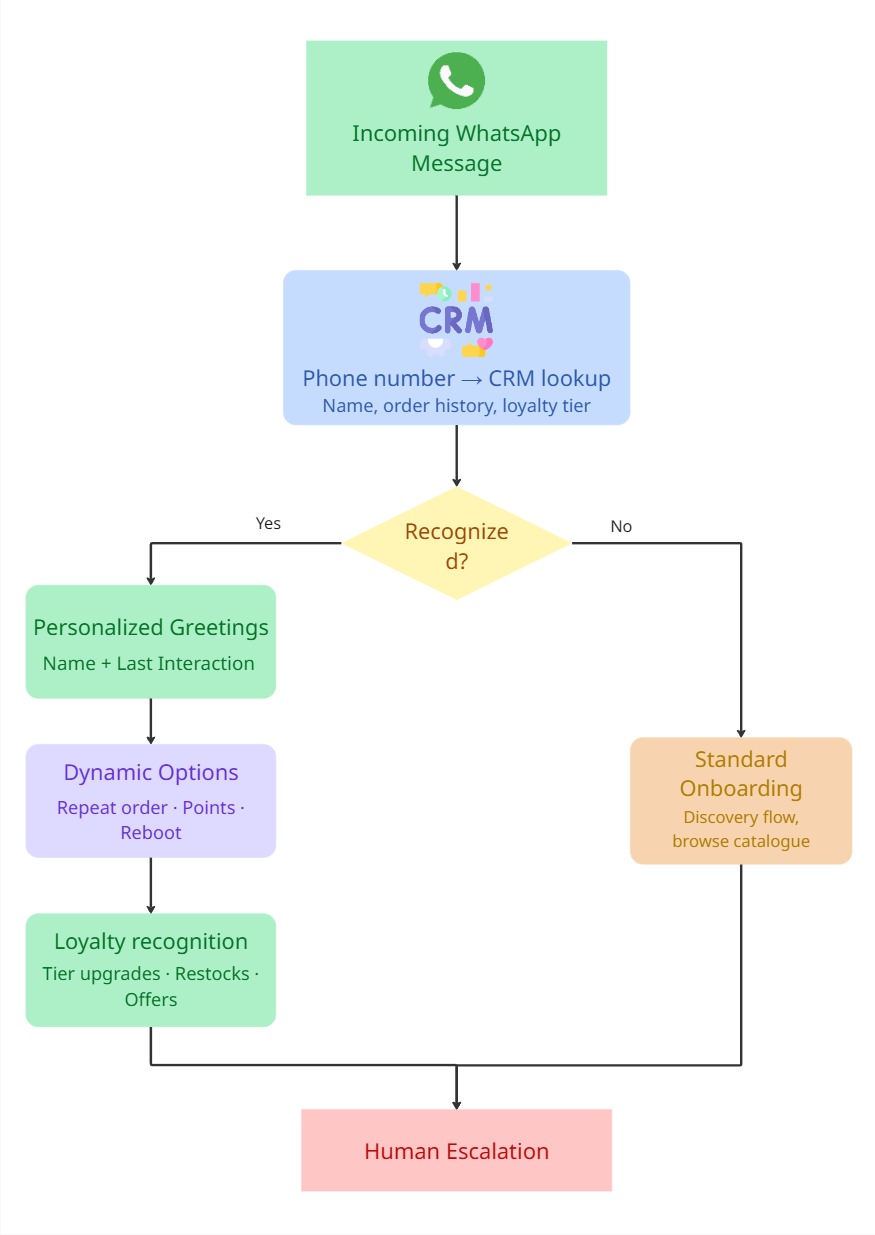
WhatsApp identification is linked to the phone number. As soon as a message lands in your WhatsApp AI Chatbot, you’ll need to match the incoming WhatsApp number against your customer database. This lookup is the foundation of the whole funnel. If the number is in your CRM, the system should pull: name, last order, frequency score, loyalty tier, and any open service tickets. If there is no match, then the customer is considered new and routed accordingly. Agentzee has native CRM integrations that make this lookup seamless and do not require you to develop custom APIs.
Design Branched Entry Flows by Segment
Once identification is complete, the funnel branches. A recognised returning customer skips the introductory qualification flow and enters a personalised greeting node. The opening message should reference their name and, if applicable, their most recent interaction. From there, dynamic quick-reply options should reflect their actual history: “Repeat last order,” “Check your loyalty points,” “Book your usual appointment,” rather than a generic product menu. First-time or unrecognized contacts follow a standard onboarding path.
Build the Repeat-Order and Self-Service Rail
For a returning-customer funnel, the most valuable feature is frictionless repeat engagement. Design a dedicated rail in the conversation flow where a customer can confirm a repeat purchase, reschedule a service, or renew a subscription in three messages or fewer. This requires your WhatsApp AI Chatbot to have write-access to your order management or booking system, not just read-access. The customer should be able to complete an action without ever leaving WhatsApp or speaking to a human.
Layer in Loyalty Recognition and Contextual Offers
Your WhatsApp AI Chatbot has a natural window at the moment of enquiry to surface relevant value. If a customer is just three purchases away from a VIP tier upgrade, notify them. Communicate to them when a product they regularly buy surfaces back in stock or on promotion. Because these moments feel like real customer service. This is not upselling, because they are relevant. With platforms like Agentzee, businesses can build these contextual triggers in their WhatsApp AI chatbot flows without having to code custom logic from scratch.
Design Graceful Escalation with Full Context Handoff
There will always be enquiries that go beyond what automation should handle, such as complaints, complex changes, and sensitive account issues. When this happens, the escalation must carry the full conversation context to the human agent. The agent should see: customer name and segment, the enquiry that triggered escalation, purchase history summary, and any actions already taken in the current session. This prevents the “please repeat yourself” moment that erodes customer trust faster than almost anything else. Define clear escalation triggers: sentiment detection, explicit “speak to a person” requests, or specific enquiry categories flagged in your flow.
A Sample Flow Structure in JS
For technical teams implementing this logic on a WhatsApp Business API setup, below is a simplified representation of how the identification-and-branching logic at the entry of the funnel can be structured.
This JS code section is illustrative in showing
Incoming WhatsApp webhook handler:
async function handleInboundMessage(payload) {
  const { phone, message } = payload;
Step 1: Look up the customer by phone number
const customer = await crmLookup(phone);

if (!customer) {
    // New or unrecognised contact → standard onboarding flow
    return routeToOnboardingFlow(phone);
}
Step 2: Score the relationship
const segment = classifySegment({
purchaseCount: customer.totalOrders,
daysSinceLastOrder: customer.daysSinceLastOrder,
loyaltyTier: customer.tier
});
Step 3: Fetch the recent order for the quick-repeat option
const lastOrder = await getLastOrder(customer.id);Step 4: Build a personalised greeting message
const greeting = {
    to: phone,
    type: "interactive",
    interactive: {
      type: "button",
      body: {
        text: `Welcome back, ${customer.firstName}! 👋\n\nYour last order: ${lastOrder.summary} (₹${lastOrder.total}). Want to repeat it?`
      },
      action: {
        buttons: [
          { type: "reply", reply: { id: "repeat_order", title: "Yes, repeat it" } },
          { type: "reply", reply: { id: "new_order", title: "Browse menu" } },
          { type: "reply", reply: { id: "my_account", title: "My account" } }
        ]
      }
    }
  };
Step 5: Attach a loyalty nudge if the threshold is close
if (customer.pointsToNextTier <= 50) {
greeting.interactive.footer = {
text: `🎁 ${customer.pointsToNextTier} points to ${customer.nextTier} status!`
};
}

await sendWhatsAppMessage(greeting);
logConversationStart(customer.id, segment);
}
This pattern lookup, segment, personalise, and offer context is the engine behind every effective returning-customer funnel. On top of this core, the conversation logic is what makes it feel human.
Putting Everything Together
The goal of this funnel is not to replace the human relationship but to digitally mirror the intelligence that great human relationships carry. When a returning customer messages your business on WhatsApp, the system should know enough to start the conversation at the right place, offer the right options, and get out of the way quickly.

Getting to that point isn’t about one tool doing everything. It’s usually a mix of a few things working together in the background. You need the WhatsApp setup in place so messages can actually come in and go out properly, not just plain text but richer interactions too. Then there’s some kind of system where customer details and past conversations are stored. Without that, every interaction resets to zero.
And then there’s the chatbot layer on top of that, which is really what connects all of it. It’ll understand the context, figure out the tone at that moment, then proceed to the conversation going in a way that doesn’t sound too robotic or fake.
The Solution for You Might be Agentzee
If you don’t want to put it through a full engineering cycle to deploy, Agentzee has a purpose-built platform for WhatsApp AI chatbot development that does all the integration plumbing, CRM connections, conversation branching, loyalty triggers, and human handoff within a no-code or low-code environment. It is a practical starting point for teams who want to move from generic automation to genuine customer recognition.
The regulars who have chosen your business, again and again, are already doing something remarkable. The least your WhatsApp channel can do is notice and remember.
Let me offer you a simpler solution, which is Agentzee.
In addition to WhatsApp, we offer AI chatbots for Facebook and Instagram. Also, we have additional third-party platform integrations and a voice call campaign.