
Maha has answered eleven calls before her coffee cooled on April 14 at 8:53 a.m.
“Did you get my documents?” was the first thing each one said. “When is my filing due?” “Has my return been filed yet?” Different sounds. Five questions are the same. Eleven times in under an hour.
She works as a senior associate at an accounting firm with 12 people. Not a customer service agent. You wouldn’t know the difference for six weeks every year, though.
This is the quiet crisis that hits all accounting firms at the same time, just like the tax code itself. And the usual solution, hiring temporary workers, training them for two weeks, and hoping they don’t quit before April 30th, costs between ₹30,000 and ₹50,000 per season when you add in the costs of onboarding, supervision, and the inevitable gaps in knowledge. Inbound AI voice agents in accounting firms are changing that number completely.

Why hiring temp staff is a broken solution
The amount of work during tax season doesn’t slowly go up. It hits like a brick wall.
In the three weeks leading up to filing deadlines, many accounting firms see call volumes several times higher than usual. Most of those calls aren’t hard. They’re checking on their status. Confirmations of documents. Clients who are worried and emailed you something four days ago want to know if you got it.
Those calls are not the right ones for your senior staff. They cost a lot, are qualified, and can handle things that really need expertise. But they spend a lot of time in the first quarter letting people know that their W-2s arrived safely.
That’s what it really costs. Not just the number of calls, but also the loss of talent.
There is a different problem when you hire temps. You spend two weeks training someone who doesn’t know much about your business, your clients, or how you do things. They answer calls with only half the information. Customers see. By the third week, that temp is either too busy or gone, and your senior staff is back on the phone anyway.
It’s a costly way to fix part of the problem.
The office hours may close, but the calls won’t
Tax season doesn’t punch a clock. A client remembers the missing document at midnight. The deadline panic call at 11 p.m.? They just read something scary on Reddit.
In a traditional firm, it goes straight to voicemail. The client tosses and turns all night, then calls back first thing in the morning. Their call gets added to a queue that was packed even before business opened.
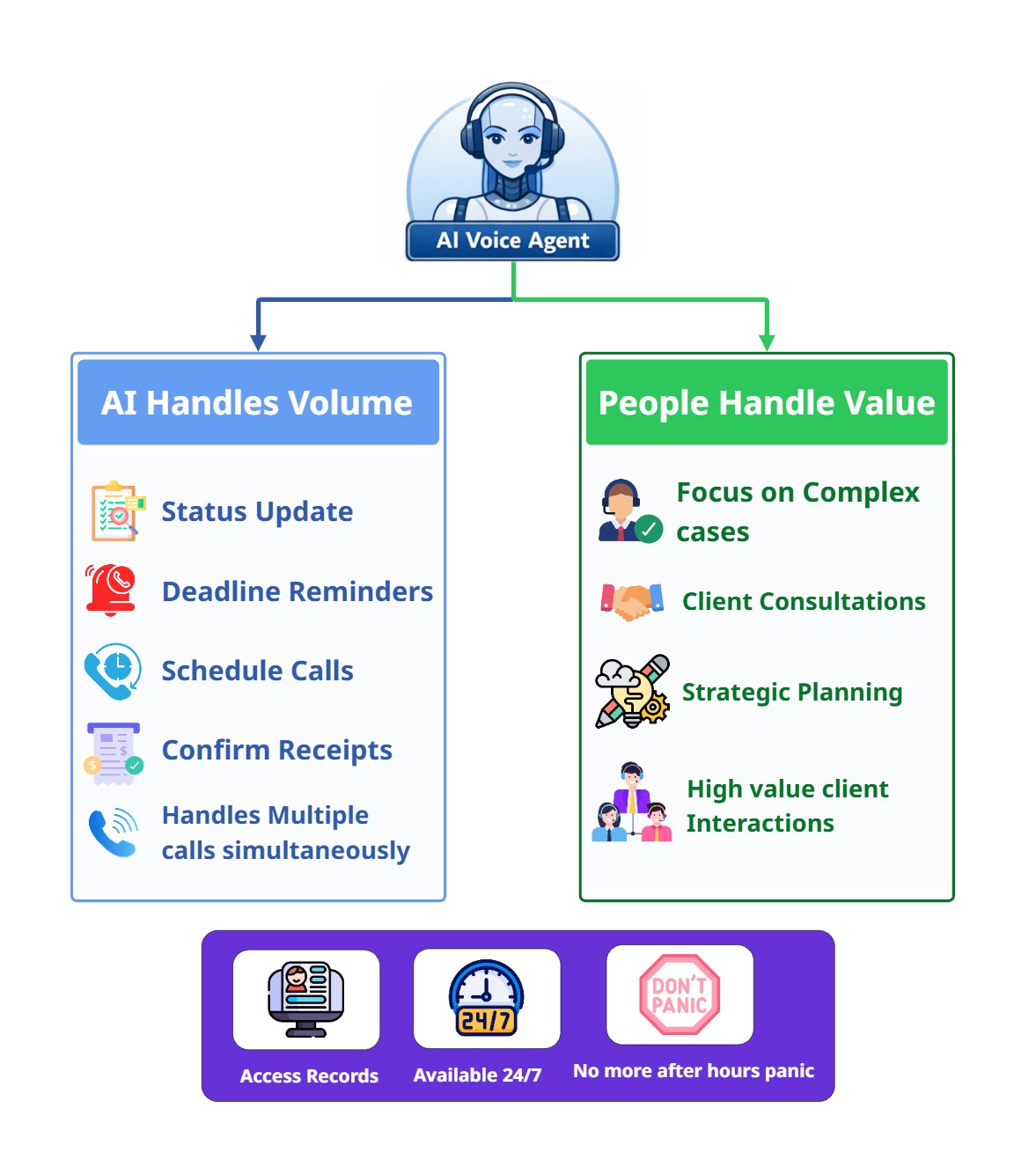
Inbound AI voice agents at accounting firms don’t shut down at the end of the day. The same system managing your 10 a.m. rush is fully active at 10 p.m., accessing client records, answering questions, and maintaining consistent accuracy. No after-hours drop-off, no reduced service.
If that late-night call needs a document, the WhatsApp handoff works exactly like it does at noon: Client submits at midnight; it’s in your system before your team even arrives in the morning. Your staff walks into resolved questions instead of a voicemail backlog, so that the first hour of their day can be actual work!

What’s the role of the Inbound AI voice agent in accounting firms
It’s an easy shift to understand. The AI takes over the low level stuff like status updates, deadline reminders, scheduling calls, confirming receipts, and lets your trained employees focus on the calls that truly matter.
Inbound AI voice agents at accounting firms respond immediately. They take multiple calls at once. They won’t keep a client on hold for nine minutes just because someone has left the room. And they aren’t like a temporary worker; they already know your client list, retrieving records, filing status updates, and current tasks in real time from your practice management software, whether that be Canopy, Karbon, TaxDome, or even if you are using a custom setup.
A client calling in late-night stress before a deadline gets immediate help from the AI, without waking your staff.
This leads to a better division of labor: AI handles volume; people handle value.
The moment the Inbound AI voice agent hits a wall, and what happens next
The honest truth: not everything gets solved on a voice call.
A client needs to send corrected W-2s, which means you cannot get a PDF over the phone. Someone is calling about an amended return that requires identity verification, but the background noise makes voice recognition difficult. Another one wants to upload a Schedule C correction? None of this works in audio alone.
This is where the WhatsApp handoff really shines.
When the voice agent runs into trouble with a document request, a verification failure, or anything that requires structured input, it doesn’t end the call. It triggers a channel switch instead. The client gets a WhatsApp message within seconds after the call ends; it acknowledges that particular conversation, explains what’s needed from them now, and provides direct upload links or guided forms.
Think of it more like a relay race than just handing off something between two people, where one person passes over an object to another waiting runner already in motion, so that there is no time lost transferring from one individual to another! In this case, everything transfers smoothly since both parties were talking before!
The AI chatbot on WhatsApp continues with all details left behind by the voice conversation, no need for the client to say their name again or confirm account numbers again or restate why they called in the first place, because it already knows! This would take three back-and-forth emails over two days for document collection, but here it is reduced into one self-contained thread completed by the client at their convenience with AI follow-up if they go quiet.
No reintroduction required; No dropped context happens; No “let me transfer you to someone who can assist.”
Clients who would’ve complained anyway
There is a certain kind of tax season caller that every firm knows all too well. A client of eight years, calling twice a week in April. Not hard, just anxious, and anxiety can bypass any IVR queue faster than lightning.
In fact, it is precisely in these situations that inbound AI voice agents at accounting firms shine brightest.
The AI picks up immediately. It knows the client’s name, their filing status, what has been received and what is outstanding because it retrieved their record before the greeting finished playing. The client gets a real answer within twenty seconds. Not a hold queue, not a promise of a callback later, but an answer.
That experience, fast, informed, calm, turns an anxious caller into one who becomes less frequent until finally stopping altogether at four times per week; not because he or she has been ignored but because satisfaction comes on the first try.
Will this work for every client? Absolutely not! Some clients will always need human intervention from word go, penalty notice in hand, dispute brewing or multi-entity complexity requiring judgment calls to be made. That’s perfectly okay! This is precisely what escalation paths are meant for. The AI picks up on the signals of complexity and flags the call to route it to the right staff member who already has a prepared summary in hand.
Inbound AI voice agents in accounting firms: What the data shows after one season
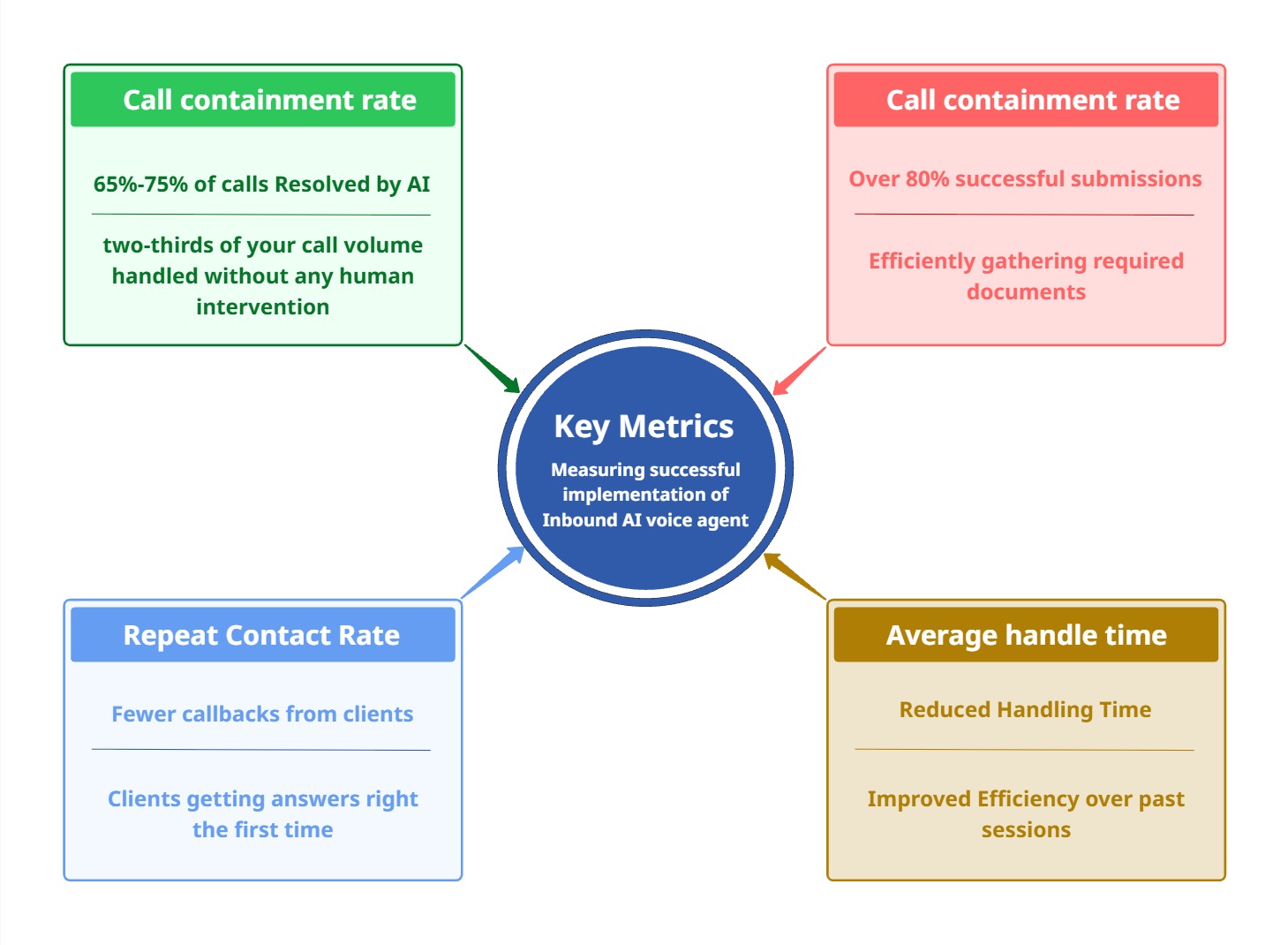
Companies that use inbound AI voice agents usually focus on four key metrics, which reveal the true picture:
Call containment rate - the proportion of incoming calls fully resolved by AI without human intervention. As an illustration, a well-configured agent might resolve around two-thirds of calls in its first tax season. That would be two-thirds of your call volume dealt with without any staff member picking up the phone.
WhatsApp document completion rate - this is a percentage of channel handoffs that result in successfully submitted documents; when the handoff happens quickly and what is required is clear, it runs above 80%.
Repeat contact rate - a significant drop here indicates that clients are getting real answers the first time and not calling back because they are unsatisfied or confused; this is basically what tells you whether the AI is really serving its purpose or just working technically.
Average handle time compared to last tax season - this one your partners will inquire about and will also be one that makes for a very short next budget discussion when you can present it.
Conclusion
Tax season is always stressful. That will never change.
However, it is up to the accounting firms to decide how they will take in that stress. Inbound AI voice agents at accounting firms receive all calls without requiring overtime, without needing to onboard temporary staff, and without exhausting your top employees on enquiries that do not require their attention.
The volume is managed by the Inbound AI voice agent. Document management is taken care of by the WhatsApp chatbot. Real work gets done by your team when it actually needs them.
This is not magic; this is just a more efficient separation of tasks designed for resilience under pressure.
Curious what this looks like for your firm? Agentzee creates incoming AI voice agents and WhatsApp AI chatbot systems for professional services companies looking to manage high-demand times without increasing staff numbers.
Handle more calls without hiring more staff. Please check out our product
Build a smarter, faster WhatsApp channel. You can also explore our product