
Shalini calls her bank in the afternoon on a Wednesday to change her direct debit mandate. The AI inbound voice agent greets her, collects her intent, and starts the verification flow. Then: biometric mismatch. She does not sound like the person whose voice sample is enrolled. A flag is raised.
This is where Shalini’s story ends on a traditional IVR call drop; she redials, re-explains, and waits. She thinks about switching banks, but quietly never calls back.
With a multi-channel AI setup, that moment is not failure but rather a fork in the road.

Why voice communication often falls short
Voice call is a strong way to make first contact. It is also limited in terms of structure.
Some journeys just can’t be finished on a call. For example, uploading a photo ID, submitting claim documents, or entering structured data without three rounds of misrecognition. When you add background noise, strong accents, or a customer who just finished talking, the dead-end situations get even worse.
Running support only by voice is like doing your taxes over the phone. Possible in theory. Very unpleasant. No one is doing their best work.
The usual answer is to send the person to a human agent or end the conversation. Both are costly, one in terms of the number of people needed and the other in terms of the value of a customer over their lifetime.
The AI inbound voice agent-to-WhatsApp AI chatbot switch gives you a third option.
Old way: Call hits a wall. The ticket is back open. Customer effort: a lot.
New way: Call finds a wall. Conversation changes channels. Customer effort: almost none.
How an AI Inbound voice agent seamlessly shifts conversations to a WhatsApp AI chatbot
Here is the technical part, short like I promised.
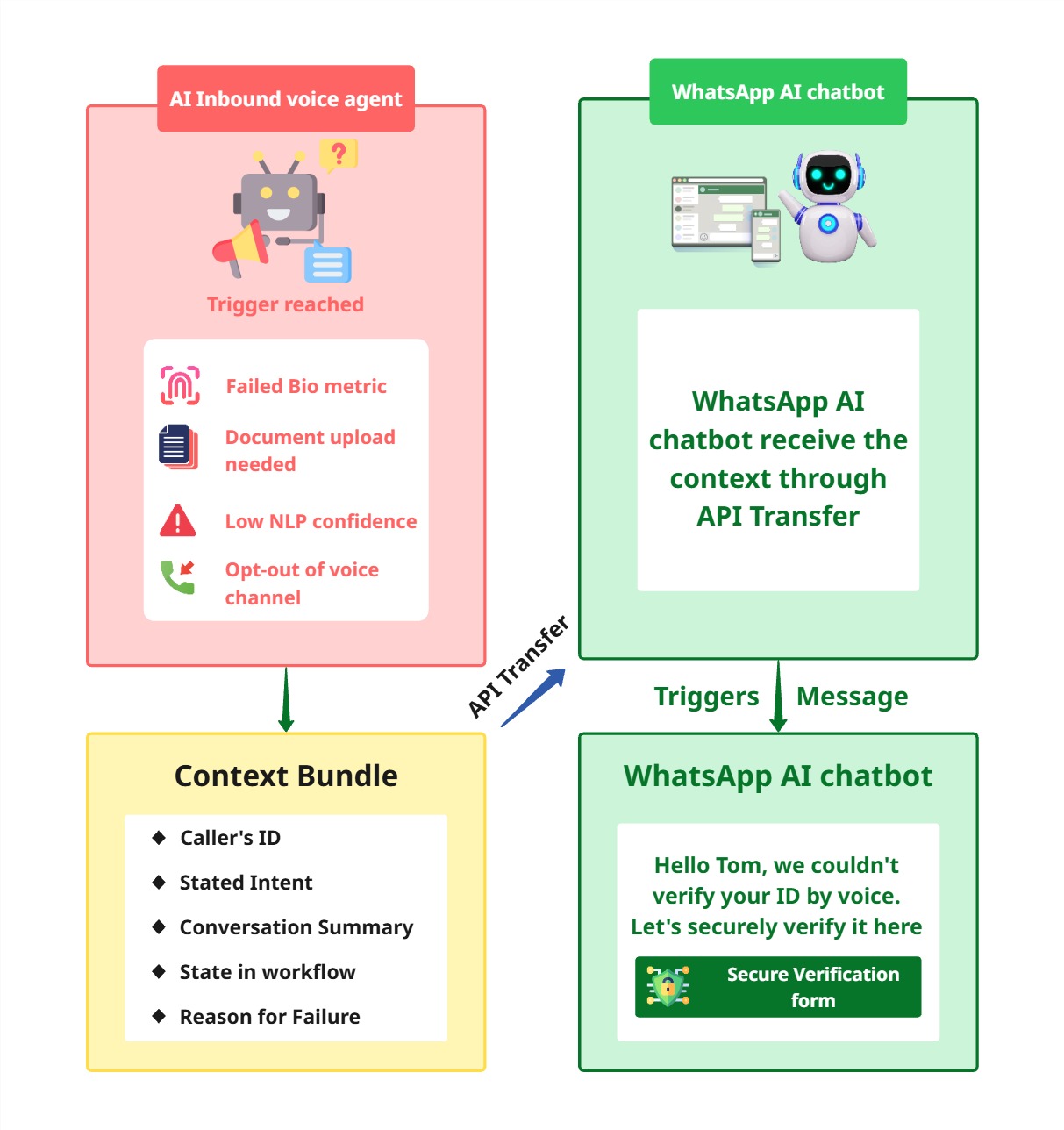
When the AI inbound voice agent reaches any of the pre-set triggers, which are: failed biometric, document upload required, NLP confidence below threshold, or a customer opting out of the voice channel, it will package up a context bundle. This includes caller identity, stated intent, conversation summary, current state in workflow and reason for failure. That gets transferred via API to the WhatsApp AI chatbot within seconds.
The customer gets a WhatsApp message that acknowledges the call and one sentence describing what has changed, plus one next action: secure form, document upload link, or verification step.
The WhatsApp AI chatbot starts with full knowledge of what happened before in voice. No name re-entry, no restating intent, just continue the sentence that was started by the voice agent. That’s it for architecture. Clean, deliberate, and almost seamless for the end user.
The business case comes down to one metric: customer effort score
Customer Effort Score (CES) has one purpose: to measure how much effort a customer had to put in to get something done. Not how happy they were. Not whether they’d recommend you. Just to calculate, was it easy or difficult?
Customers don’t walk away just because they’re unhappy; they leave when it starts to feel like too much work: three calls, two queues, and explaining the same thing one too many times. CES picks that up, while satisfaction scores do not catch that.
Without the pivot, a failed voice interaction turns into an obstacle course with four steps:
Hang up and dial again
Re-authenticate
Explain again to another agent
Find your way in another channel
Every single step takes away from retention.
Early deployments of voice-to-WhatsApp handoff workflows have led to a 30–45% drop in repeat contact rates and a clear rise in the number of problems that are solved on the first contact. Instead of starting over, customers finish the journey in one thread.
What it actually takes to do this right
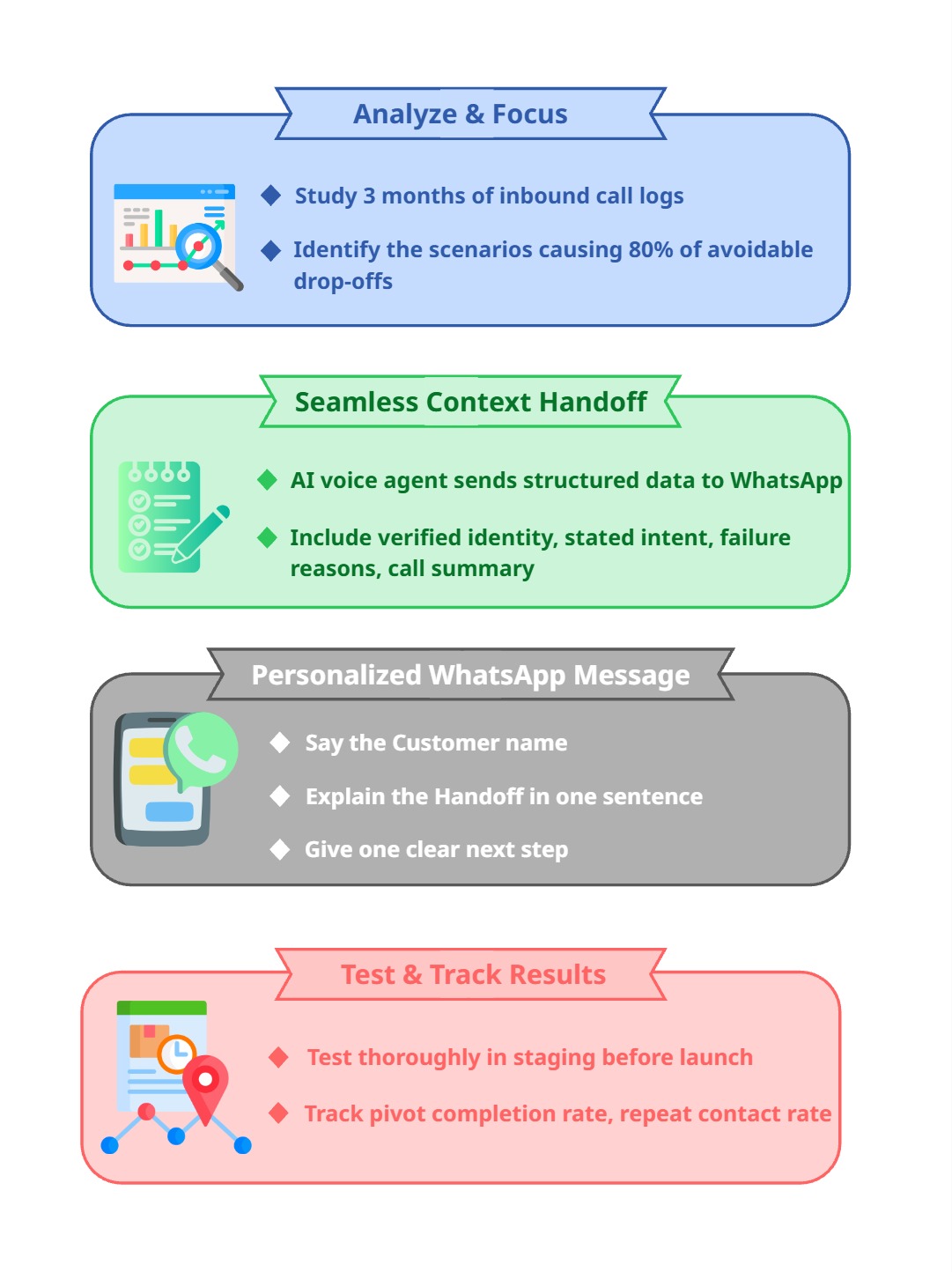
Start with your data, not your ambitions. Get three months’ worth of inbound call logs, figure out where journeys go wrong, and find the three or four failure patterns that cause 80% of avoidable drop-offs. Those are the things that set you off. Start by creating clear rules for three scenarios instead of messy ones for ten.
The context handoff is where implementations gain or lose trust. The AI inbound voice agent needs to send the WhatsApp AI chatbot structured information, such as the person’s verified identity, their stated intent, a summary of the conversation, and the reason for the failure. Not a raw dump of a transcript. A clean package that the chatbot can act on right away, so the customer doesn’t think there was a system error.
People don’t give the WhatsApp message enough credit. It should do three things:
Say the customer’s name
Explain the switch in one sentence
Give them one thing to do next
One tap. If someone just failed voice authentication, tell them straight out, “We couldn’t verify your identity by voice; let’s do it securely here.” Specific reassurance sounds like competence. When someone gives you vague reassurance, it sounds like panic.
Before going live, test everything in staging. After going live, keep track of the pivot completion rate, the repeat contact rate, and the time it takes to resolve issues. The architecture is working if those three numbers go up in the right direction within 30 days.
How it works across industries
It’s not only a banking issue. There are moments in every industry when a voice call initiates the task, but cannot complete it.
In a healthcare situation, when a patient calls to file an insurance claim, the AI inbound voice agent recognizes the intent. However, since the claim requires images of prescriptions and discharge summaries, the call shifts to WhatsApp so that the patient can upload these documents at their convenience and proceed with the claim without any human involvement.
In logistics, if a customer calls about a damaged delivery, voice can confirm the order, while WhatsApp will gather the necessary photos. The exception gets filed and a replacement triggered without ever requiring that customer to log into some forgotten password-protected portal.
When a customer wants to change their SIM card, they call the telecom. The voice agent gets the request, but to finish it, you need to send in a photo ID and an OTP. Neither of those works when you’re on the phone. The AI inbound voice agent then sends the call to WhatsApp, where the customer can go through the steps at their own pace and get it done.
Different sectors share the same challenge: the call begins the work, but the WhatsApp AI chatbot brings it to completion without requiring the customer to restart.
Conclusion
Here’s the thing: it won’t be invisible to all customers from day one. Some will notice the channel switch. Some will find it strange. That’s okay, a brief “oh, I just got a WhatsApp from my bank” is better than a dropped call followed by another queue.
What makes an implementation good or great is tone, speed, and context. The WhatsApp message has to feel like the call kept going, not like it failed and the system was trying to save itself.
Get those elements right, and the customer does not experience a channel switch at all. They perceive a conversation that continued when all logic dictated it should have stopped.
This is the design philosophy behind Agentzee’s AI inbound voice agent and AI WhatsApp chatbot, a shared context layer so every handoff is a continuation rather than a restart.
If you wanted to turn every call into a completed conversation. Please check out our product
If you want to convert conversations into sales. You can also explore our product