
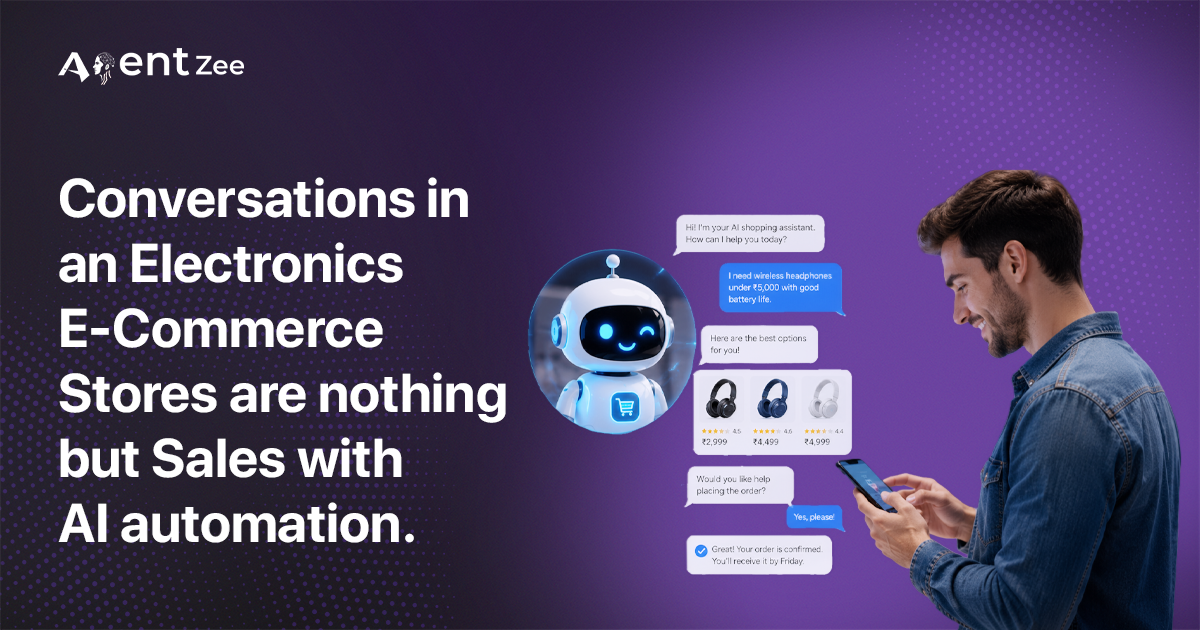
The electronics e-commerce space is a rough one. Customers want fast answers, easy checkout, and dependable help after they buy. But for many growing businesses, keeping up with all that isn’t easy. Support teams get overloaded, replies slow down, and customers quietly move on to someone else.
The good news is that there is now a practical way for businesses to address this. An AI chatbot on WhatsApp, Instagram, and the website can really make a difference. It’s not about taking over your team but helping the business manage more customers and more questions and, eventually, more orders without falling apart.
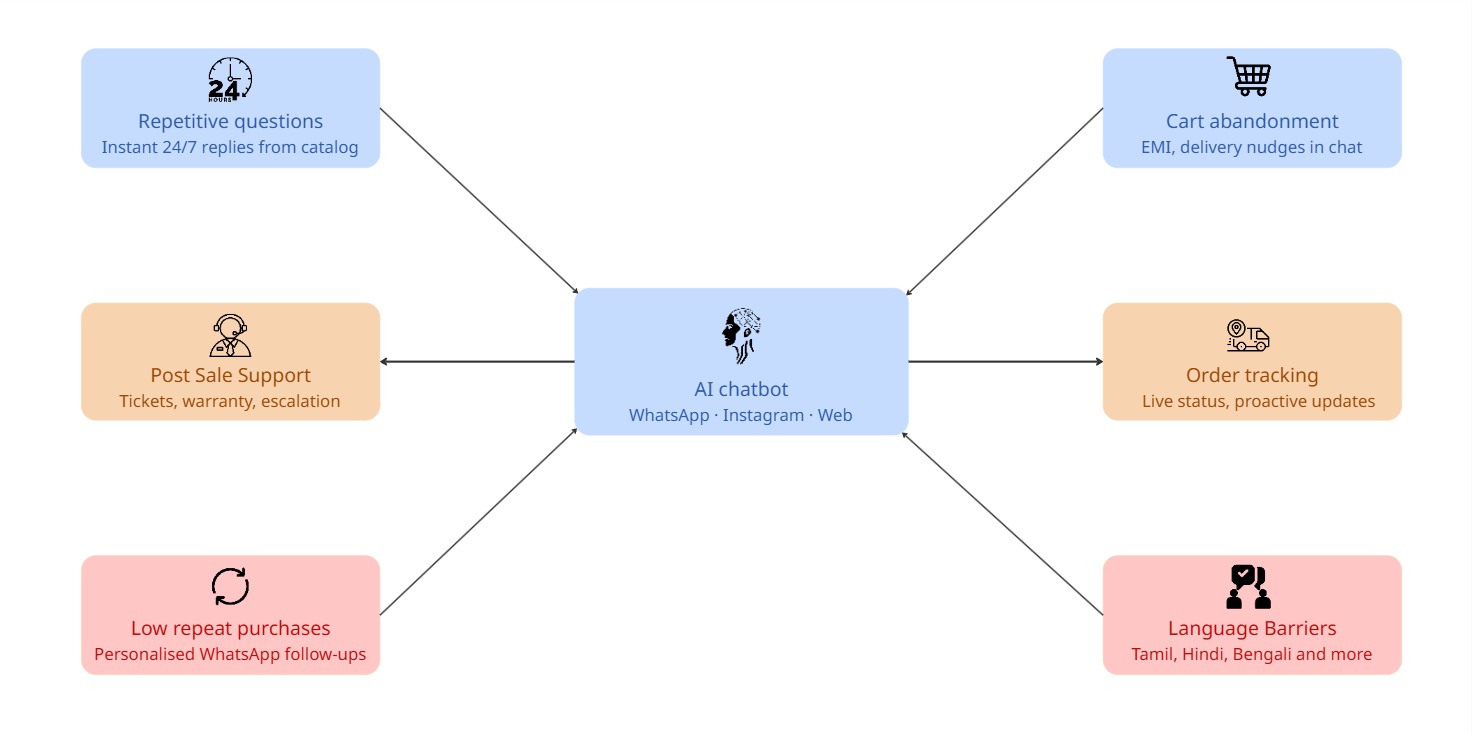
A peek into everyday problems that an electronics store faces, and also explaining how a chatbot can make a difference in that situation.
The same product questions keep coming back
Ravi sells laptops, smartphones, earphones, smart home devices, and many more gadgets online. His inbox is flooded with similar types of questions most of the time, like the following: What is this laptop’s configuration? How many drivers does this earphone have? Will a Mac support this?

His two-person support team spends most of the day answering the same things again and again. They end up copy-pasting product details instead of helping with more serious issues.
By the afternoon, reply times are already crossing two hours. A lot of customers do not wait that long. They just leave.
How the chatbot answers product questions
The chatbot on Ravi’s website and WhatsApp can reply to these questions right away, at any given hour. The product catalogue information stored in its knowledge base can provide information on the products’ specifications, compatibility, warranty, stock, and many more in just a matter of seconds.
Even though a user visits his website at 1 AM and makes enquiries like “Does this laptop support a memory upgrade?” They will get an answer almost immediately.
Likewise, the chatbot can manage up to a significant amount of incoming enquiries based on its architecture capabilities on its own. This gives the support staff more space to focus on complicated issues and genuine escalations.
Too many people abandon their carts
Priya’s analytics reports are showing a pattern that’s becoming impossible to ignore. There are lots of users who add products to the cart, go to the checkout page, and then disappear as if they never existed.
When she looks closer, the reason becomes clear. Many of them had simple doubts, like, Is EMI available? Will this arrive before the weekend? Can I return it if there is a problem?
These are not big concerns, but without quick answers, customers leave.
How the chatbot recovers abandoned carts
The chatbot can also link to payment and delivery systems to provide real-time answers around shipping timelines and EMI options based on the cart and the customer’s location.
That kind of timely nudge can recover a good number of abandoned carts.
A lot of buying on the Instagram platform begins with the reels and ads on it. So when a user sends a message from a reel, our chatbot can respond to DMs. Also, it can explain product details and even send a payment link inside the same conversation.
Support after a sale gets messy.
Karthik sells TVs and home theater systems online. For him, the sale is not the hard part. What comes after is the real headache.
Customers message him regarding product installation, issues with it, pairing the remote, warranty claims, and service requests. These messages come to him across platforms like WhatsApp, Instagram, and email. But mostly they are on WhatsApp. Also, his team has no proper system to keep track of what has been solved and which requests are still pending. Due to this reason, messages are missed, and the customers get frustrated. So, reviews getting worse become inevitable.
How the chatbot handles after-sales support
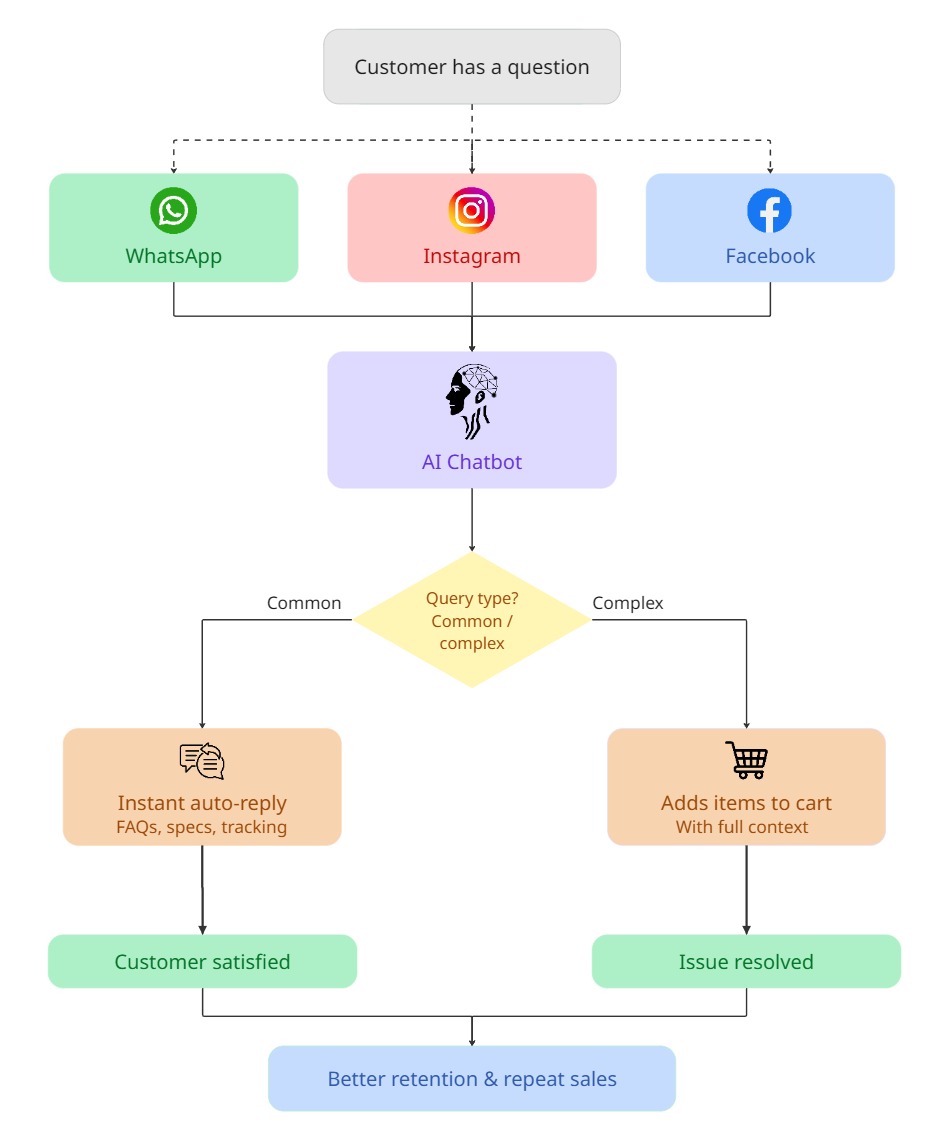
A chatbot can act as an initial support system. Whenever a customer reports any problem across any of these platforms, namely WhatsApp, Instagram, or a website, our bot will ask for the order ID. It will understand the problem to an extent. In some cases, if the problem is a common one, it will resolve problems by itself or generate a support ticket for the correct team member.
It will all sound good at first, but if the WhatsApp inbox is left unchecked for a while, it quickly becomes impossible to manage. For that very specific reason, “nothing gets lost” because every conversation is recorded.
For a warranty claim, chatbots can walk the customer through a step-by-step process and collect all the documents needed. This eases the job once a physical agent steps in.
Order tracking questions pile up during busy periods
On festive days, Ananya’s electronics store will most probably get almost three times the usual orders. That sounds great at first, but her WhatsApp inbox becomes a mess, making it impossible to manage.
Almost every second message is the same.
Where is my order?
When will it arrive?
Her team cannot keep up, and the delay starts creating more problems. Some customers complain, some open disputes, and some leave bad reviews.
How the chatbot answers order-tracking questions
A chatbot integrated with the order management system can respond to tracking queries automatically. When a customer asks where their order is, the bot can request the order number or locate the order by phone number, and then retrieve the live shipping status and respond immediately.
There is no reliable way of reaching out to past buyers. It works at midnight just as well as during office hours.
When an order is out for delivery or delayed, it can also send proactive updates, which reduces the number of incoming tracking messages in the first place.
Customers buy once and never return
Siddharth sells mobile accessories. His first sales experience is good, but repeat purchases are weak. To earn them as repeat customers, he takes some steps, like sending out promotional emails. But it has no effect because these days no one reads promotional emails. He posts on Instagram, but the engagement is inconsistent. Also, there is no credible way to remain in touch with previous customers.

Most customers purchase once and then forget the store.
How the chatbot brings customers back
Out of all platforms, WhatsApp has the highest message open rates.
Consider, a few months back, a customer who bought a phone case would get a promotional message like, “We have got you some new accessories that match well with your model based on your previous orders.”
That feels useful instead of annoying because it is connected to what the customer already bought.
On Instagram, the chatbot can also reconnect with people who interacted with a post or ad but never completed the purchase. It can answer questions they left behind or send them a relevant offer in DM.
Regular follow-up is the magical key that turns most one-time buyers into our repeat customers.
Language is still a barrier for many buyers
Customers across Indian states like Tamil Nadu, Maharashtra, West Bengal, and Rajasthan contact Meera’s Electronics Shop, but a lot of the product’s content is in English. She knows she is losing sales because some customers are not fully comfortable buying in a language they do not use every day.
But to be realistic, a business of her scale can’t hire regional customer service for each regional language of her customer base.
How the chatbot handles different languages
A chatbot that can converse in almost every regional language, like Tamil, Malayalam, Marathi, Telugu, Bengali, Hindi, and many more, is a multilingual communication chatbot. A customer who sent a message on WhatsApp in a specific regional language will also receive the response in the same language sent by the bot. This creates a difference in the purchasing dynamics by making it more convenient. It also builds trust, particularly in marketplaces where customers are far more likely to purchase if they can ask questions in their own native language.
Bulk and B2B enquiries need more care
Arjun sells IT equipment and has started getting more bulk orders from small businesses in the process. Laptops for office use, routers for hotels, and headsets for call centres. These are bigger deals and often more valuable than retail purchases.
The problem is that a B2B buyer tends to ask many questions, such as about custom pricing and follow-ups. Arjun’s team deals with retail customers, so they often take too long to respond or lack context.
How the chatbot handles bulk and B2B enquiries
A chatbot can spot B2B-style enquiries based on quantity, question type, or a customer selecting a business enquiry option.
From there, it can collect the requirements, share an initial product list, ask the right qualifying questions, and then hand over the full conversation to the sales team.
By the time the team takes over, they already have the important details. That makes closing the deal much easier and prevents the enquiry from getting ignored or delayed.
Wrapping it up
Every one of these problems is real. Electronics e-commerce businesses face them every day, and they usually get worse as the business grows. More customers mean more messages. More messages mean more pressure. More pressure will eventually lead to delays in processing or even mistakes and, in some cases, misinterpretations throughout the sale, which leads to an unhappy buyer or a cold lead eventually.
Across multiple platforms, such as WhatsApp, Instagram, and the website, an AI chatbot deployment is not just a flashy add-on but a practical business tool. It helps a business to reply faster, serve more people than it could, manage more complexity, and achieve it without adding the same amount of cost and workload.
The businesses that grow well in electronics e-commerce are not only the ones with the best products but also the ones that provide better customer service. They are the ones who stay available for customers at every step, on every channel, at any hour. A well-built chatbot makes it that much easier.
If you are running an electronics e-commerce business and your team always feels behind, this is worth looking into. The tech is already there, the setup is manageable, and the results usually show up sooner than people expect.
Let me offer you a simpler solution, which is Agentzee.
(Agentzee WhatsApp AI chatbot)
In addition to WhatsApp, we offer AI chatbots for Facebook and Instagram. Also, we have additional third-party platform integrations and a voice call campaign.