

It’s 9:31 PM on a Tuesday. Aarav, a final year engineering student, is bracing for the GATE exam in six weeks while racing to finish a part-time project due tomorrow. Yet he uses his remaining energy to visit the websites of two shortlisted universities. He fills out both the enquiry forms and submits them both.
Half an hour later, one school had already won him over. The other has lost him forever.
Neither admissions team will know this happened until the numbers come in next quarter.
This is essentially how Admission with an AI chatbot works, within minutes of the student’s first click and the moment he closes his laptop.
Two Schools. One Student. A Real-Time Split Screen.
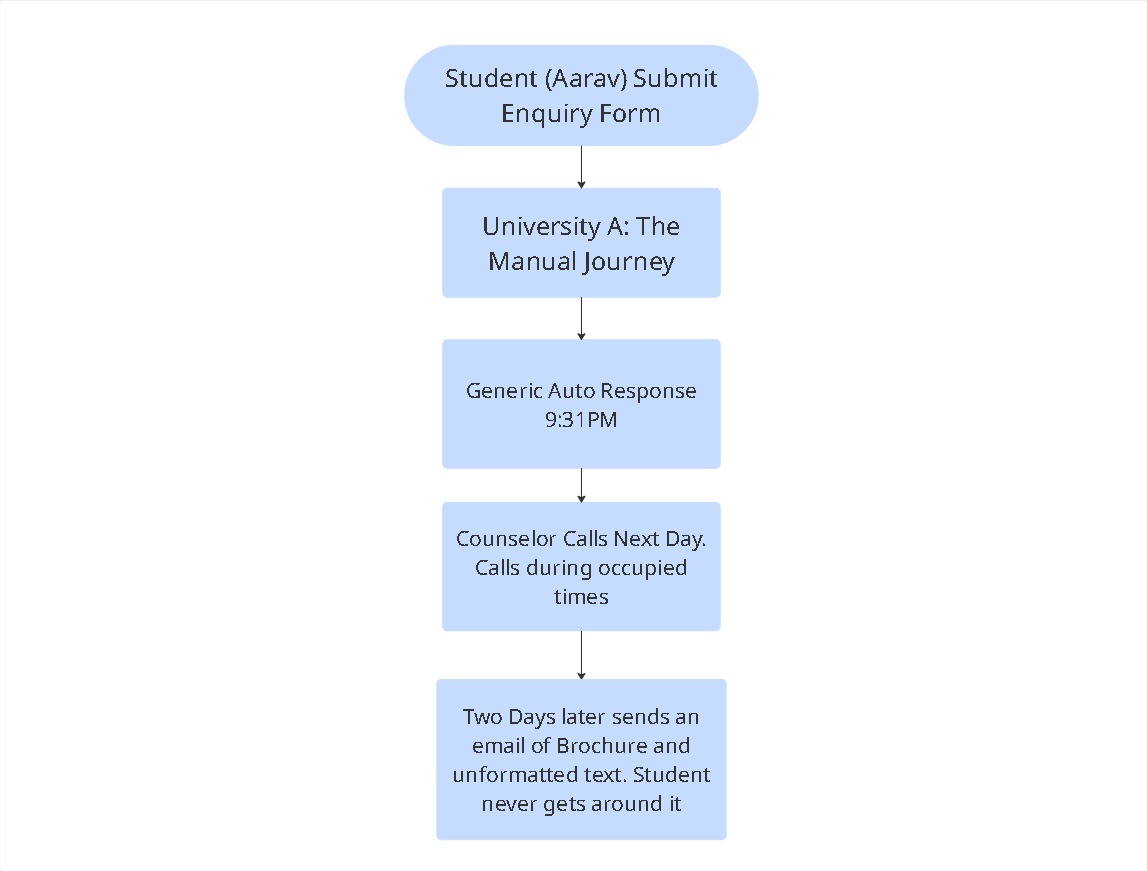
University A: The Manual Journey
By 9:31 PM, Aarav submits the form. Sequentially, an auto-generated response fires: “Thank you for your enquiry. Our team will get back to you within 2–3 business days.”
That’s it. That’s the entire response. At 9:31 PM, when Aarav is sitting with his laptop open, the school sends him a sentence that says we’ll talk when it’s convenient for us.
The next morning, a counselor calls at 11:15 AM, while Aarav is in a lab session. He declines the call.
A follow-up call comes around 2:30 PM. He’s in a lecture. Another miss.
An email arrives two days later with a brochure PDF attached, opening on mobile to a wall of unformatted text covering fee structures, batch timings, accreditation details, and hostel policies. Aarav meant to read it. But never got around to it.
By day three, the momentum is gone. University A still has Aarav in their CRM marked as “Follow-up pending.”
He’s not pending. He’s gone.
University B: The AI-Led Journey
Let’s take a look at how this plays out when a chatbot is involved.
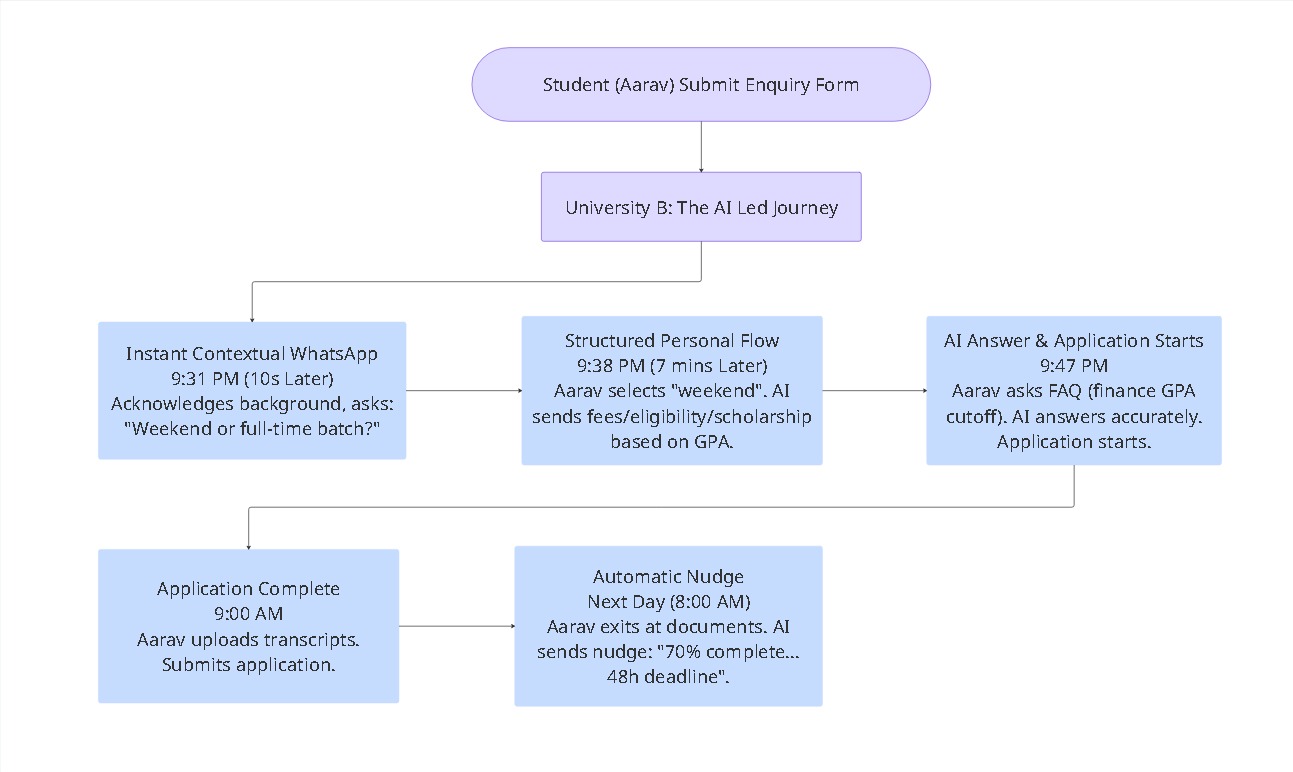
At 9:31 PM, Aarav submits the form. Ten seconds later, a WhatsApp message arrives.
Not a template, rather a contextual, structured response that acknowledges his engineering background, confirms the intake he selected, and asks one question: “Are you looking at the full-time or weekend batch?”
He replies: weekend.
The AI, integrated, immediately routes him to the weekend-batch information flow. It sends a clean, mobile-formatted fee breakdown, a structured message, and follows with an eligibility criteria for the merit scholarship, determining whether he qualifies, based on his stated GPA.
It’s 9:38 PM. Seven minutes in. Aarav now knows his fees, his eligibility, and his scholarship options. He hasn’t spoken to a single human.
At 9:47 PM, he asks: “What’s the minimum GPA cutoff for the finance specialisation?” The AI answers in under fifteen seconds. Accurately.
Aarav doesn’t close the tab. He starts the application.
At 10:14 PM, he gets to the document upload section and stops; he doesn’t have his transcripts scanned. He exits.
The next morning at 8:00 AM, before any counselor has had their first coffee, Aarav receives a WhatsApp nudge: “You’re 70% through your application. The merit scholarship deadline is in 48 hours. Please start uploading your transcripts. Want a quick checklist?”
He uploads. He submits.
University B gets a completed application. University A gets a ghost.
This Isn’t Magic. Here’s How It’s Actually Built.

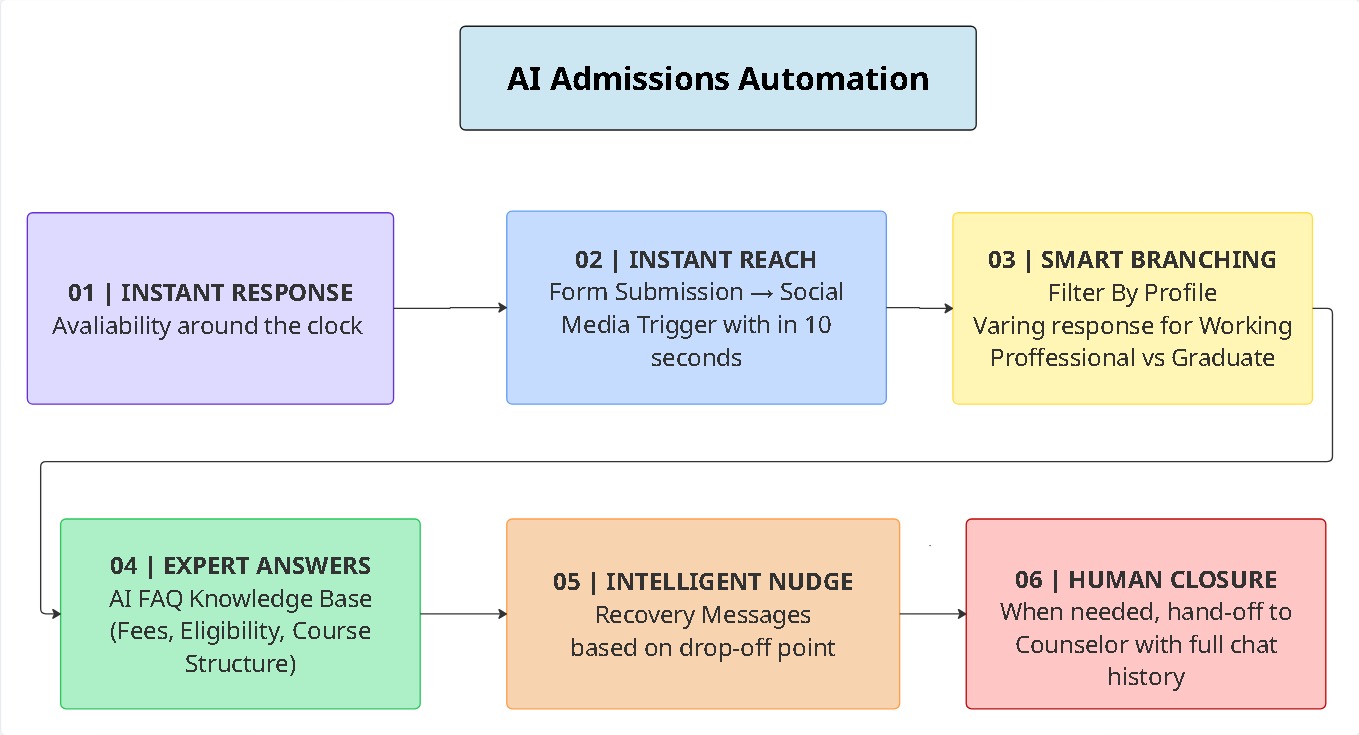
AI admissions automation isn’t a single tool. It’s a sequence of connected systems working without gaps. Here’s how institutions are building it:
Step 1: Connect Your Enquiry Form to a Real-Time Messaging Channel
The action: Route every form submission to WhatsApp or SMS within 10 seconds using a workflow trigger, not an email.
Admissions emails are often left unopened, while WhatsApp messages are usually read within minutes. The channel choice alone changes the game. Platforms like Agentzee connect your enquiry form submissions to WhatsApp Business API flows in real time, without custom development. The trigger fires the moment the form is submitted, regardless of time.
Common mistake: Teams set this up during business hours only. Aarav enquired at 9:31 PM. The automation must run 24/7, or you’ve built a very expensive daytime-only solution.
Step 2: Build Conditional Flows by Student Profile
The action: Use a branching logic based on the student’s stated preference, full-time vs. weekend, domestic vs. international, and work experience to serve the right information immediately.
A working professional asking about weekend batches and a fresh graduate asking about full-time programs have entirely varying priorities. Sending both the same brochure is equivalent to handing everyone the same menu at a restaurant that serves both vegan and steak. It needs to be user-specific.
Before AI admissions automation, this branching required a human counselor to read the form, think, and respond. Now it’s a decision tree that fires in seconds.
Step 3: Answer Eligibility Questions Instantly
The action: Train your AI on a structured FAQ covering eligibility, fees, specialisations, scholarship cutoffs, batch timings, document requirements, and visa processes for international applicants.
This is where most institutions underinvest. They build the automation but populate it with vague answers. “Eligibility varies; please speak to a counselor” is not an answer. It’s a door closed in the student’s face at midnight when no counselor is available.
Aarav’s GPA question at 9:47 PM? That answer needs to be in the system, specific, and correct. Every question a counselor gets asked more than five times per week should be in the AI’s knowledge base.
Step 4: Set Intelligent Nudges Based on Application Progress
The action: Trigger follow-up messages based on where the student dropped off in the application and not based on a generic drip calendar.
This is the difference between a nudge and noise. A message that says “Complete your application!” sent to everyone is noise. A message that says “You’re 70% done, your transcripts are the last step, and the scholarship deadline is 48 hours away” is relevant, timely, and effective.
Integrate your AI admission automation layer with your application portal so drop-off points trigger specific recovery messages. Agentzee’s workflow builder can pull application completion status and trigger conditional WhatsApp messages based on the last completed step.
Step 5: Route to a Human at Exactly the Right Moment
The action: Define escalation triggers, such as the questions the AI can’t answer, high-intent signals, or specific keywords, or if presented with an edge case, hand the conversation to a counselor with full context.
This is the step that gets skipped most often. Teams either over-automate or under-automate. The right threshold is when a student shows intent and asks about payment plans, mentions a specific intake date, or asks a question outside the AI’s knowledge base.
That’s when escalation should happen: the counselor receives the full conversation history. They’re not starting from scratch. They know Aarav wants the weekend batch, has a 7.8 GPA, is eligible for the merit scholarship, and dropped off at document upload. It transitions from a cold call to a warm close.
The Honest Admission Before We Wrap Up
Will AI admissions automation work for every student? No.
Some applicants want to speak to a human before they commit. Some questions are genuinely complex; a student with a gap year, unusual academic history, or specific accommodation needs, such scenarios can only be handled by a counselor. Escalation exists for a reason.
The goal isn’t to replace counselors. It’s to stop making Aarav wait three days for an answer he needed in three minutes. Counselors should handle the decisions, the doubts, and the edge cases. The AI handles the 9:31 PM enquiry while everyone is asleep.
Conclusion: Speed Is Now a Differentiator. Treat It Like One.
Aarav didn’t choose University B because it was better. He chose it because it was there at 9:31 PM, with the right answer, in the right channel, before he felt neglected or lost interest.
Higher education admissions used to be a game of patience. Students waited for brochures. Counselors are available during office hours. Everyone understood the pace.
That era is long gone. Now, a student who enquires at night and gets a response in the morning has already decided; they’ve just decided for someone else.
AI admissions automation doesn’t give you an unfair advantage. It gives you a fair shot at the students you’ve already paid to attract.
The funnel isn’t leaking because students are apathetic. It’s leaking because the follow-up system was built for a world where students had no other options. They do now.
If your admissions team is still playing phone tag with students who enquired three days ago, it’s worth seeing what a 10-second response rate does to your conversion numbers. Agentzee builds these chatbots and automation workflows for education institutions, with no six-month implementation, no enterprise contract required. Take a look. Agentzee website AI chatbot.